
Online gaming receives four times more criticism than sports betting on social media, according to research by FGV.
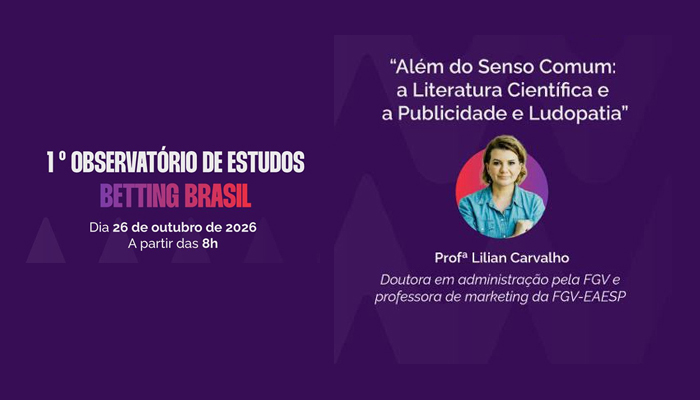
Brazilians view sports betting and online gambling (casinos) quite differently, even though both are frequently offered by the same platforms. Research conducted by Lilian Carvalho, a marketing professor at FGV EAESP, found that online gambling (casinos) receives almost four times more explicit condemnation on social media than sports betting. The survey, which analyzed approximately 30 public mentions and conducted 26 in-depth interviews with bettors, will be presented on October 26th during the 1st Betting Studies Observatory Brazil, in São Paulo.
The study reveals that, in consumers' perception, sports betting is associated with knowledge, strategy, and self-control, while online casino games, such as virtual slots (slot machines), are related to chance, addiction, and financial losses. This distinction appears both in interviews and in spontaneous comments on social media, and helps explain how bettors themselves assess the risks of each type of betting.
According to Lilian, who holds a PhD in Administration from FGV and is a researcher of consumer behavior, the results show that bettors establish a kind of moral boundary between the different types of gambling. While sports betting is often presented as an activity that requires skill and knowledge, casino games are seen as a practice of greater vulnerability.
“Our research with Brazilian bettors reveals something that regulation ignores: for the consumer, sports betting and online casinos are different worlds. The market has brought the two together under the same brand. Understanding this distinction is essential for designing any policy that aims to protect those who need protection,” says Lilian Carvalho.
The research also included an analysis of the search structure associated with a major betting operator. The results point to a contradiction between consumer perception and the sector's commercial strategy: although bettors differentiate between modalities, platforms, brands, and affiliates frequently offer sports betting and casino games under the same identity.
This dynamic contributes to a behavior identified in the interviews: participants tend to justify their own gambling as controlled activities and associate the most serious risks with the behavior of other people. In practice, the gambler recognizes the existence of problems related to gambling, but does not always perceive themselves as someone potentially exposed to them.
Advertising and gambling addiction enter the debate.
The results will be presented during the 1st Betting Studies Observatory Brazil, promoted by the Brazilian Association for Economic Freedom (ABLE), at FGV EAESP. The meeting will bring together academics, legal experts, and executives to discuss the sector's economic model, consumer behavior, and the impacts of betting regulation.
Lilian will be responsible for the closing lecture, entitled Beyond Common Sense: Scientific Literature and Advertising and Gambling Disorder . In addition to Brazilian research, the professor will present a review of international studies on the relationship between gambling advertising and gambling disorder.
The discussion takes place amidst the debate surrounding Provisional Measure No. 1.394/2026, which proposes restrictions on the operation, offering, and advertising of fixed-odds betting. According to the researcher, the formulation of public policies needs to consider not only the risks associated with the sector, but also the differences in consumer behavior and the factors that contribute to the development of gambling addiction.
Among the studies analyzed is a Norwegian survey of 5.830 gamblers, conducted by Syvertsen and colleagues in 2022, which identified more significant effects of advertising among individuals classified in higher-risk groups. The Swedish longitudinal study Swelogs, by Binde and Romild (2019), found that approximately 2% of participants reported repeated negative influence from advertising, with a higher presence of problem gamblers in this group.
A systematic review of 91 studies, published by Lopez-Gonzalez and colleagues in 2021, also identified more consistent effects of marketing among vulnerable gamblers, while the results for the general population were less uniform.
“There is a scientific consensus that rarely reaches the public debate: advertising amplifies vulnerabilities that already exist, but it does not create gambling disorder. This does not mean that advertising is irrelevant. It means that public policy needs to target those who are actually vulnerable, instead of assuming that every gambler is a potential patient,” says Lilian.
Another aspect of the presentation will be the difference between risk indicators and clinical diagnosis. According to the professor, screening tools, such as the Problem Gambling Severity Index (PGSI), identify behaviors associated with risk, but do not automatically equate to a diagnosis of gambling disorder, which is defined by clinical criteria.
The literature also indicates that gambling addiction involves multiple factors, such as impulsivity, family history, associated psychiatric conditions, and personal events. This complexity represents a challenge for prevention policies and for systems that attempt to proactively identify problematic behaviors through data from digital platforms.
“MP No. 1.394 is based on an interpretation of the problem that the literature does not fully support. My role at the Observatory is not to defend one side, but to present the evidence. If we are going to regulate, restrict, or prohibit, let it be based on what the studies show, and not on what seems obvious,” the professor concludes.
For Lilian, the Brazilian research adds an important dimension to the regulatory debate by showing that consumers do not perceive all types of betting in the same way. Understanding these differences, she says, is fundamental to evaluating the effects of advertising, developing prevention strategies, and formulating more targeted protection measures for vulnerable groups.
Service: 1st Observatory of Betting Studies Brazil
Date: October 26, 2026 (Sunday)
Time: 8am to 12pm Location: FGV EAESP, Main Hall, 4th floor. Access via Rua Itapeva, 432, Bela Vista, São Paulo (SP))
Registration and information: WhatsApp – (11) 99682-7225
Produced by: ABLE, Brazilian Association for Economic Freedom
Note: There is no parking available at this location. Public transportation or ride-sharing services are recommended.
About Lilian Carvalho
Lilian Carvalho holds a PhD in Administration from Fundação Getúlio Vargas and is a marketing professor at FGV EAESP, where she researches consumer behavior, decision science, brand management, and research methods, with an emphasis on social listening and digital data analysis. She is the founder of DigiSales Group, a market research and marketing strategy consultancy. Her current research investigates how Brazilian bettors construct and defend the legitimacy of sports betting in a market that mixes sports and casino games under the same brands.

