Lula bans betting and the black market rejoices: 428 illegal websites in three days.

In just three days, between the announcement of Provisional Measure No. 1.394/2026 and this Sunday (27), 428 new illegal bets appeared in Brazil, according to the monitoring platform Bet Legal. This is the first concrete effect of the ban on fixed-odds betting and online casinos decreed by President Lula.
The measure achieved something rare. It united in its criticism of the government media outlets that for years had treated betting as villains, with editorials, columns, and investigative reports. The weekend following the announcement, Folha de S.Paulo , O Globo , Estadão , Valor Econômico , and CNN Brasil all pointed to the same problem: the measure was enacted nine days before the first round of elections, without transition, without an impact study, and by a government that hadn't even structured the oversight of the market it itself had regulated.
"Governed by election"
The harshest tone came from an editorial in Folha de S.Paulo . The newspaper classified the ban as part of a series of "electioneering gambles" that, added together, amount to nearly R$ 200 billion. The text recalls that the harmful effects of gambling have been known for a long time and summarizes: "Instead of governing the country, Lula is governed by the election."
The editorial also exposes a fiscal contradiction. The 2027 Budget proposal, sent to Congress less than a month ago, includes R$ 5,3 billion in revenue from the sector that will now cease to exist. According to O Globo , the end-of-campaign measures (ban on betting, readjustment of Bolsa Família and Desenrola 3.0) may require adjustments of up to R$ 42,3 billion in the accounts of the next term.
The actual number tends to be higher. The Federal Revenue Service recorded R$ 9,9 billion collected by the sector between January and August 2026, a real increase of 69% compared to the same period in 2025, according to a survey by CNN Brasil . Official data from the Treasury Department obtained by BNLData via the Access to Information Law show gross revenue (GGR) of R$ 36,9 billion in 2025 and R$ 20,07 billion in the first half of 2026 alone.
The sector intends to take this matter to the Federal Court of Accounts (TCU). According to a note published by the website Amado Mundo, operators will argue before the TCU that the Provisional Measure violates the Fiscal Responsibility Law because it forgoes billions in revenue without indicating any compensation in the budget. Market estimates suggest that the current rules would generate R$ 10,8 billion in taxes for the federal government. The prohibition also dismantles a plan by the Treasury itself, which foresaw including the platforms in the new Selective Tax, with rates of 3% to 5% on gross revenue. This would yield up to R$ 2 billion extra per year. The strategy is to shift the dispute from the moral arena, where the sector loses, to the accounting field.
Four servers to monitor thousands of websites.
Vinícius Valfré's report in Estadão reveals the central weakness of the provisional measure. It demands from the government precisely what it has failed to do so far: block illegal betting operations.
The Prizes and Betting Secretariat had two employees dedicated to oversight and now has four. It is their responsibility to monitor nearly 200 authorized websites and thousands of illegal ones. Of the R$1 million allocated in 2026 for the regulation and oversight of betting and lotteries, only R$275,6 has been used so far. Government technicians themselves admit that the largest groups behind the so-called "Chinese betting" have never been reached. Since 2024, estimates have never fallen below 10 clandestine websites available per day.
The newspaper also found that influencers with millions of followers continued to share links to illegal platforms after the Ministry of Justice announced the removal of 1.367 profiles. Estadão also points to an additional problem: if the fight against illegality was already insufficient with the sector's revenue, it will now have to be done without it.
LCA Consultores estimates that the illegal market accounts for between 38% and 44% of the total. In a survey of 2.291 bettors, the consultancy found that 77% had already used a platform with illegal practices.
Those who migrate are the most vulnerable bettors.
Economists interviewed by O Globo and Valor acknowledge the weight of gambling in indebtedness, but criticize the form of the measure. Flávio Ataliba, from FGV/Ibre, states that those who migrate to illegal sites are precisely the most compulsive gamblers, not the casual ones. Therefore, the prohibition would worsen the problem for those who most need protection. Also from Ibre, Fernando de Holanda Barbosa Filho says that the timing leaves no doubt about the electoral motivation.
With the ban, all the mechanisms created by Brazilian regulations themselves disappear: facial biometrics, blocking of minors, veto on credit cards, self-exclusion, deposit limits, and daily blocking of beneficiaries of Bolsa Família and BPC. None of them exist on the black market.
The "crutch" that now has numbers.
The Estadão newspaper argues that the legal market has turned the specter of the illegal market into a crutch, used against any tightening of regulations. This is a legitimate criticism when the argument is presented without evidence. That is not the case now.
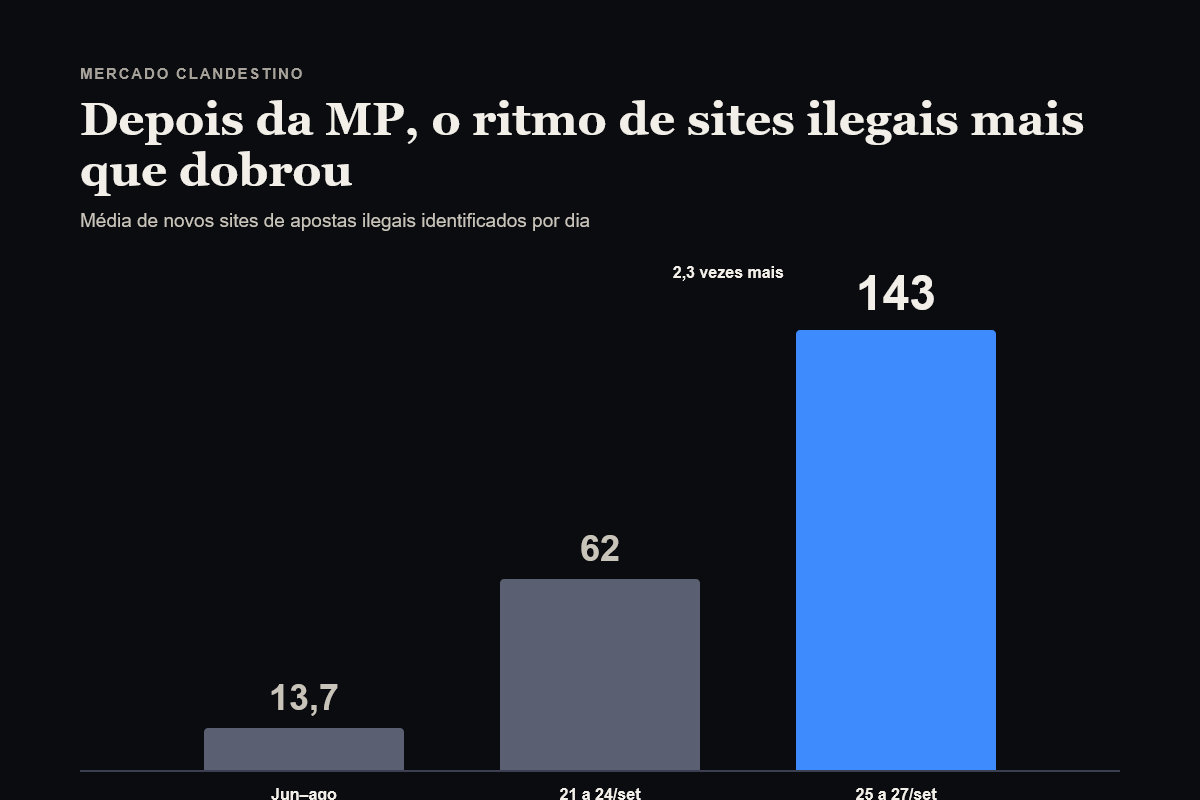
Bet Legal identified 674 new illegal betting sites between September 21st and 27th. The pace had already accelerated during the days when Lula threatened to ban the sector: there were 246 between the 21st and 24th, about 62 per day. After the announcement of the Provisional Measure, the average more than doubled: there were 428 sites between September 25th and 27th, about 143 per day. For comparison, ANJL had registered 13,7 new illegal domains per day between June and August.
The president of ANJL, Plínio Lemos Jorge, told Globo that clandestine websites are taking advantage of the situation, many copying the visual identity of authorized platforms. Estadão itself admits that the government has no way to take them down: there are four servers and at least 10 clandestine websites available per day.
Migration is no longer a lobbying hypothesis. The black market is preparing to receive gamblers, and the state, according to the newspaper's own report, lacks the structure to prevent it.
Legal uncertainty and a billion-dollar bill
In Valor and on CNN , lawyer Fabiano Jantalia, president of the Gaming Law Commission of the OAB-DF (Brazilian Bar Association of the Federal District), classified the Provisional Measure as the greatest legal outrage in the history of Brazilian economic law. The 85 authorized companies each paid R$ 30 million for five-year concessions, totaling R$ 2,55 billion. The government has already warned that it will not return the amounts. The Attorney General of the Union, Jorge Messias, says that the measure was "rigorously validated".
According to Bernardo Cavalcanti Freire, legal consultant for ANJL and partner at Betlaw, the measure should have been preceded by an economic and legal impact study. This study would transparently determine the compensation due to those who invested and paid a fee to operate legally. Speaking to the Painel SA column of Folha de S.Paulo newspaper , Freire states that the State cannot ignore the financial consequences of making an activity unviable that it itself authorized through payment.
CNN also showed that a unanimous 2020 Supreme Court decision recognizing the states' authority to operate lotteries could create a loophole against Article 2 of the Provisional Measure, which extends the ban to state lotteries. Lawyers, however, consider an injunction before the election unlikely. Experts cited by Valor believe the issue could also reach the Superior Electoral Court (TSE) due to alleged abuse of political power.
According to O Globo , around 180 executives and lawyers from the sector decided to act as a bloc in the Supreme Court and leave the offensive in Congress for after the first round of elections.
Football without a Plan B
The clubs are the most sensitive flank for the government. Betting companies injected approximately R$ 1,03 billion into Série A in 2025, according to the consultancy Convocados, cited by Folha . Flamengo receives R$ 268,5 million per season from Betano and says it has no plan B. Fluminense has already been notified by Superbet about the possible termination of a contract worth R$ 58 million annually. The Planalto Palace has scheduled a meeting with the clubs for next week, but without a defined proposal.
Television also loses its share.
The domino effect hit the broadcasters on the same day as the Provisional Measure. According to the column "Outro Canal" in Folha de S.Paulo, Betano, Novibet, Superbet, and Esportes da Sorte are among the companies that have already announced the termination of their contracts with television networks. Globo, ESPN, and Band rushed to remove advertisements scheduled for the following hours from their programming. SBT is still evaluating what to do. At Disney, owner of ESPN, a task force was assembled hours before the signing to ensure that no betting advertisements would air.
The impact goes beyond commercial breaks. Globo had an exclusive quota for the sector in the broadcasts of the Copa do Brasil and the Brasileirão. Band had sold the naming rights of programs like Jogo Aberto and Os Donos da Bola to betting companies , which are already airing without the brands. Both broadcasters are looking for advertisers in the market to fill these spaces.
Broadcasters should not charge penalties for contract terminations. The strategy is to negotiate an amicable exit and keep the doors open for a possible return of regulation, since the prohibition was made by provisional measure. To the market, TV companies admit to fearing a drop in revenue and layoffs. It's not a small amount of money: between January 2024 and August 2026, companies in the regulated market invested R$ 23,6 billion in media, according to data from Ibope and Tunad. Television concentrated 74% of these resources in 2025, well above the average for the advertising market, which was 54%. As Fabiano Jantalia warned, transmission contracts with sponsorship quotas already sold became impossible to fulfill overnight.
Questionable electoral effectiveness
Even the electoral return is questioned. A survey by the Ideia Institute, cited by Valor, showed that only 2% of respondents pointed to gambling as the main cause of their debt. Supermarket and utility bills topped the list.
In Thaís Oyama's column in O Globo , Renato Meirelles, from Locomotiva, states that the end of betting is well received among independent voters, but it doesn't quite determine their vote. Maurício Moura, from Ideia, believes the measure may have come too late.
Even opponents who support the ban criticize the way it was done. Governor Tarcísio de Freitas said he was against the game, but called the provisional measure electoral opportunism. He questioned why the sense of urgency only appeared on the eve of the vote.
Testing the research
The voter will give the first signal this Monday (28). According to Veja , Quaest and BTG/Nexus are releasing new surveys with fieldwork that reach the announcement of the ban. Nexus interviewed 2.000 voters by telephone between September 25 and 27 (registration BR-07557/2026). Quaest interviewed 2.004 voters in person between 24 and 27 (registration BR-06520/2026). Both have a margin of error of two points.
Polls indicate a close race. In the latest Quaest poll, from September 21st, Lula had 37% in the first round, against Flávio Bolsonaro's 33%, and the senator appeared numerically ahead in the second round, 42% to 41%. In the previous Nexus poll, Lula scored 40% against 37% in the first round and 46% to 45% in the second.
Quaest will ask directly about the topic. Voters will say whether they were already aware of the restrictions on gambling, especially online casinos and the "tiger game," and whether they approve or disapprove of the measure. The questionnaire separates those who already knew about the prohibition from those who learned about it during the interview, and also tests the readjustment of the Bolsa Família program and the free offer of slimming pens.
The cleanest test will come from Datafolha. According to columnist Lauro Jardim, from O Globo , the institute will go into the field between Tuesday (29) and Thursday (1st), with publication on the same day, shortly before the Globo debate. It will be the first major survey with all the fieldwork done after the announcement. The columnist describes it as perhaps Lula's last attempt to use the presidential pen to win votes before the first round.
2.506 voters will be interviewed in person, the largest sample in the national series for this election, with a margin of error of two points. The questionnaire has two questions on the topic:
"In your opinion, should online sports betting, also known as betting sites, and online casinos be banned or not?"
"Do you or anyone living in your household usually gamble online, at betting sites or online casinos?"
The second question may be the most revealing. In April, Quaest indicated that 29% of Brazilians had the habit of betting online. Since Datafolha now measures the entire household, and not just the interviewee, the number should give a true picture of the public affected by the ban, and pushed into clandestinity, just days before the election.
The worst-case scenario
The Estadão newspaper summarizes the most likely outcome: Lula issues the provisional measure to try to win the election, Congress lets it expire, and everything goes back to normal, in both the legal and illegal markets. In the meantime, gamblers migrate, companies accumulate losses, and the state loses revenue and control.