
MEsp establishes partnership to expand research production in the field of electronic games and eSports.
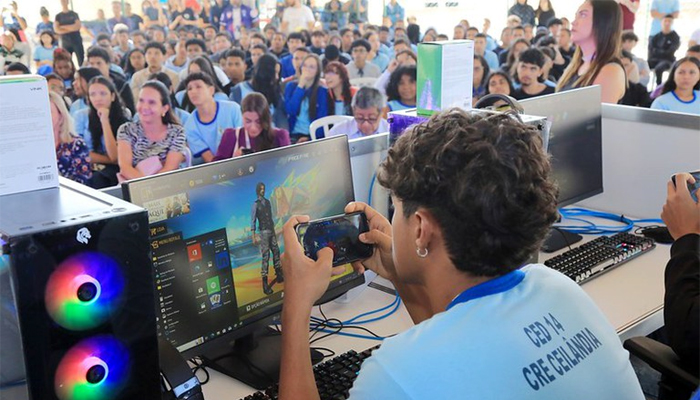
To expand knowledge production on electronic games and eSports, the Ministry of Sport has signed a technical cooperation agreement (ACT) with the Federal University of Lavras (UFLA), in Minas Gerais. The partnership will allow for the mapping of games in Brazil, the development of research, the production and elaboration of public policies aimed at the sector, as well as guaranteeing the presence of an institutional delegation at the 1st edition of the eSports Olympic Games, to be held in 2027 in Riyadh, Saudi Arabia.
The agreement aims to train professionals capable of working in different areas of electronic games and eSports, and to develop research projects focused on the practical application of acquired knowledge. Furthermore, it seeks to create a qualified and engaged technical team dedicated to promoting eSports as tools for inclusion, innovation, and social impact.
“This partnership marks a decisive step in consolidating electronic games and eSports in Brazil. It symbolizes a commitment to the future — a future in which universities, sports organizations, companies, and the public sector walk together, building knowledge, opportunities, and development. With this union, we will be able to define guidelines and best practices that strengthen the growth of eSports in a sustainable, organized way, based on educational values. But, above all, we want to expand access, promote digital inclusion, and ensure that more people can be part of this vibrant, creative, and transformative universe that is the world of electronic games,” stated the National Secretary of Sports Betting and Economic Development of the Ministry of Sports, Giovanni Rocco.
“We have taken a big step for eSports in Brazil. With an educational and pedagogical focus, addressing topics that require care and responsibility from the Ministry of Sport — such as the creation of guides and strategies for preventing and combating match-fixing in games, cyberbullying, the impacts on players' mental health, gender issues, the use of prohibited substances (doping), and practices involving so-called loot boxes, among others,” explained the director of eSports, Marcio Zuba de Oliva.
Strengthening the modality
With this initiative, the field of electronic games and eSports will be strengthened through connections between universities, sports organizations, companies, and government agencies. This structure will allow for the creation of guidelines and regulations for the practice and management of eSports, promoting sustainable and organized growth. Committees or working groups are also planned within UFLA and partner institutions to manage and structure the technical, ethical, and social aspects of eSports, focusing on inclusion and educational impact.
In Brazil, data from the Game Brasil survey reveals the population's strong involvement with electronic games: 74% play regularly, with a particular emphasis on adults between 35 and 39 years old, and a female participation rate of 50,9%. Furthermore, 79,5% cite games as their main form of entertainment. The agreement also foresees the strengthening of the esports community, encompassing players of different levels—amateur, semi-professional, and professional.
The official recognition of electronic games and eSports began to gain momentum in 2021, when the International Olympic Committee (IOC) included specific recommendations on virtual sports in Agenda 2020+5 and promoted the first Olympic Virtual Series. Since then, the movement has advanced with the holding of Olympic Esports Week (2023) and the announcement of the Olympic eSports Games, in partnership with Saudi Arabia. ( AsCom – Ministry of Sport )

