
Does Brazil really tax betting operators less? The data shows otherwise.

"Taxes on betting in Brazil are lower than in other countries."
This has been the headline of several articles published in recent weeks, even used as one of the justifications for proposing an increase in the GGR tax rate. The analysis, however, almost always starts from the same point: the isolated comparison of the 12% rate with that of international markets such as Italy and the United Kingdom.
It is true that, looking only at GGR (Gross Revenue Management), Brazil appears to be a country with a more lenient tax system. However, this conclusion quickly falls apart when we broaden our perspective to include the total tax burden borne by companies in the sector.
The problem is that this narrative creates the impression that Brazil taxes the regulated market lightly, when in fact the opposite is true. When looking at the full tax burden, the picture changes completely.
The mistake lies in ignoring the most basic fact: no company is taxed solely by a sector-specific tax, but by a broad range of taxes.
In the United Kingdom, one of the most mature and stable markets in the world, the logic is straightforward. Taxation focuses essentially on two pillars:
⇒ GGR: 15% for sports betting (GBD) and 21% for online gaming (RGD);¹
Profit: 25% Corporate Tax.²
With this structure, the final effective load ranges between 36% and 41%.
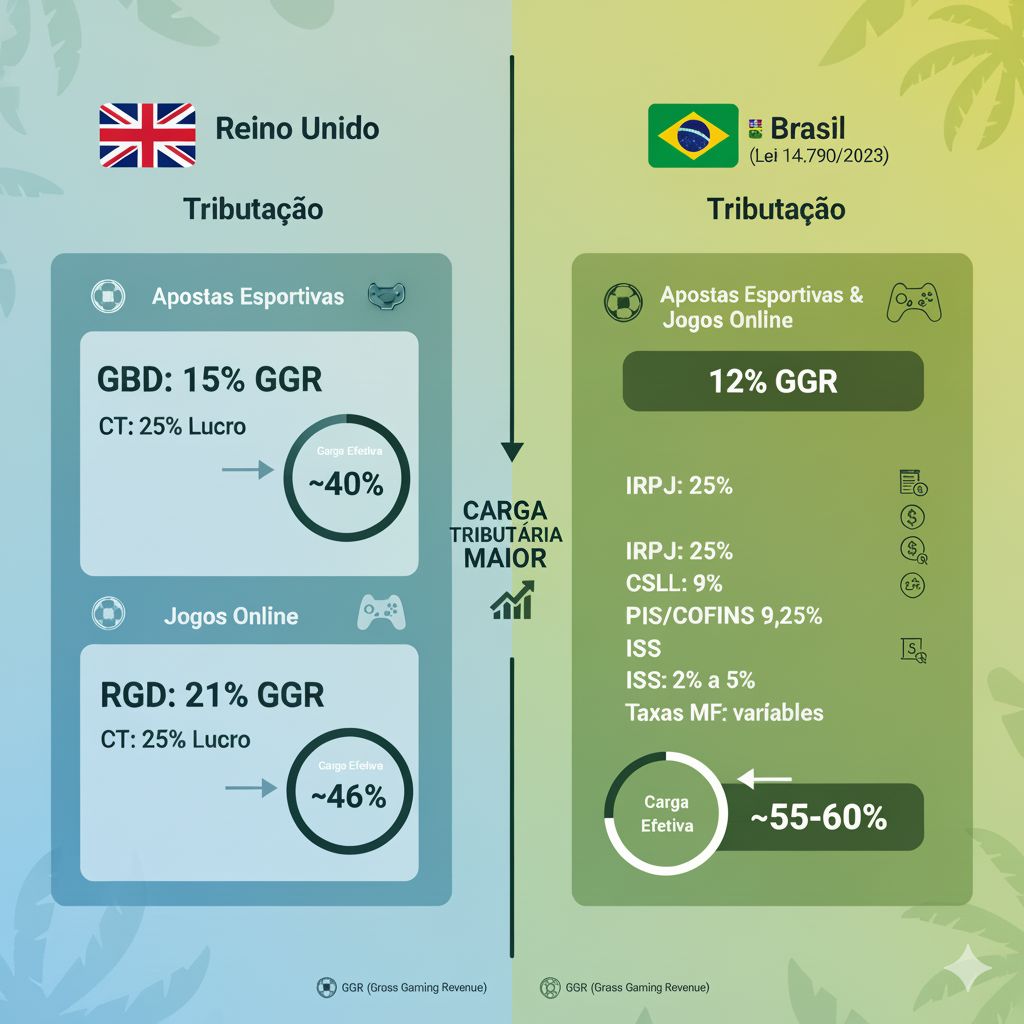
In Brazil, Law 14.790/2023³ also defines the GGR as the primary base. However, all existing general taxes are accumulated on top of it:
⇒ Corporate Income Tax (25%);
⇒ CSLL (9%);
⇒ PIS/COFINS (9,25%);
⇒ ISS (2% to 5%); and
⇒ Regulatory fees proportional to revenue.
The result is an effective tax burden in the range of 57,25%⁴ to 60,25%⁵, much higher than that of countries frequently used as a benchmark. And well above virtually every relevant regulated market.
In other words, even though the UK taxes online gambling at 21%, it's still cheaper to operate there than here.
And if the projects under consideration in the Senate are approved⁶, raising the GGR to 18% or 24%, the final effective tax burden increases to approximately 64,25%⁷ to 70,25%⁸, without considering inspection fees, labor charges, operational costs, etc.
Let's be honest: what competitive operator can sustain a model built this way?
And that's precisely the crux of the discussion: a tax system that aims to protect the market and strengthen regulation, in practice, produces the opposite effect.
Formalization becomes more expensive, riskier, and, for many operators, simply unfeasible. As a result, the illegal market becomes more attractive, the exact opposite of what is expected from an efficient regulatory environment.
In any sector (finance, telecommunications or betting) the result is always the same: burdening the regulated operator strengthens the irregular operator.
Effective regulation is not synonymous with high taxes, but with consistency, simplicity, competitiveness, and long-term sustainability.
Ultimately, the question we need to ask is: do we want a regulated market that works, or just a regulated market on paper?
Brazil has the opportunity to choose which path to follow. And poor regulatory choices, once consolidated, are difficult to correct.
(*) Yasmin Farias is a lawyer and postgraduate student in Compliance & ESG at the University of São Paulo (USP/Esalq). Member of the Gaming, Betting and Responsible Gaming Law Committee of the OAB/SP (São Paulo Bar Association) and of the Compliance Working Group for Municipal Lotteries of ANALOME (National Association of Municipal Lottery Administrators). She works with regulation, governance and integrity in the betting sector.
***
¹HM REVENUE & CUSTOMS. General Betting Duty, Pool Betting Duty and Remote Gaming Duty. GOV.UK, August 14, 2014. Last updated April 29, 2024. Available at: https://www.gov.uk/guidance/general-betting-duty-pool-betting-duty-and-remote-gaming-duty. Accessed November 17, 2025.
² HM REVENUE & CUSTOMS. Rates and allowances for Corporation Tax. GOV.UK, 14 Apr. 2013 (published) — last updated 6 Apr. 2025. Available at: https://www.gov.uk/government/publications/rates-and-allowances-corporation-tax/rates-and-allowances-corporation-tax. Accessed on: 17 Nov. 2025.
³ BRAZIL. Law No. 14.790, of December 29, 2023. Provides for the lottery modality called fixed-odds betting; amends Laws No. 5.768, of December 20, 1971, and 13.756, of December 12, 2018; revokes provisions of Decree-Law No. 204, of February 27, 1967; and provides other measures. Official Gazette of the Union, Brasília, Dec. 30, 2023. Available at: https://www.planalto.gov.br/ccivil_03/_ato2023-2026/2023/lei/l14790.htm. Accessed on: Nov. 17, 2025.
⁴ Considering a minimum ISS of 2%
⁵ Considering a maximum ISS of 5%
⁶ FEDERAL SENATE. Higher taxation of betting and fintechs returns to the CAE agenda on Tuesday. Senate Agency , November 14, 2025. Available at: https://www12.senado.leg.br/noticias/materias/2025/11/14/maior-taxacao-de-bets-e-fintechs-volta-a-pauta-da-cae-na-terca-feira. Accessed on: November 17, 2025.
⁷ Considering an average ISS of 3% for estimating the new GGR rates
⁸ Id.

