
The magic number of bets: how an indirect calculation of Pix turned into a "loss of 1,1% of GDP" in a national headline.

A report published by Agência Brasil and replicated by dozens of media outlets — including Money Times — stated that betting “may have cost” Brazil up to 1,1% of its GDP by 2025, with a loss of R$ 120 billion to R$ 141 billion in economic activity. This information originates from a note by the Center for Research in Macroeconomics of Inequalities (Made), at FEA/USP, signed by economist Guilherme Klein — the same author of estimates on the betting sector previously challenged by this newsroom.
BNLData went to the primary source of the note — published on the Made website on August 24, 2026 — and to the study that serves as the basis for the central number used throughout the account: a bulletin from the Celso Furtado International Center (CICEF), in partnership with Comsefaz. What is found there is a chain of estimates, hypotheses, and borrowed proxies that journalistic coverage has turned into a fait accompli.
What the report said
According to the article, a "study" by USP (University of São Paulo) concluded that sports betting will remove between R$ 120 billion and R$ 141 billion from the Brazilian economy in 2025, cause a loss of revenue of up to R$ 54,8 billion, account for up to 14% of the increase in household debt, and increase income concentration in the richest 1% by up to 2,1%.
What the BNLData fact-check found:
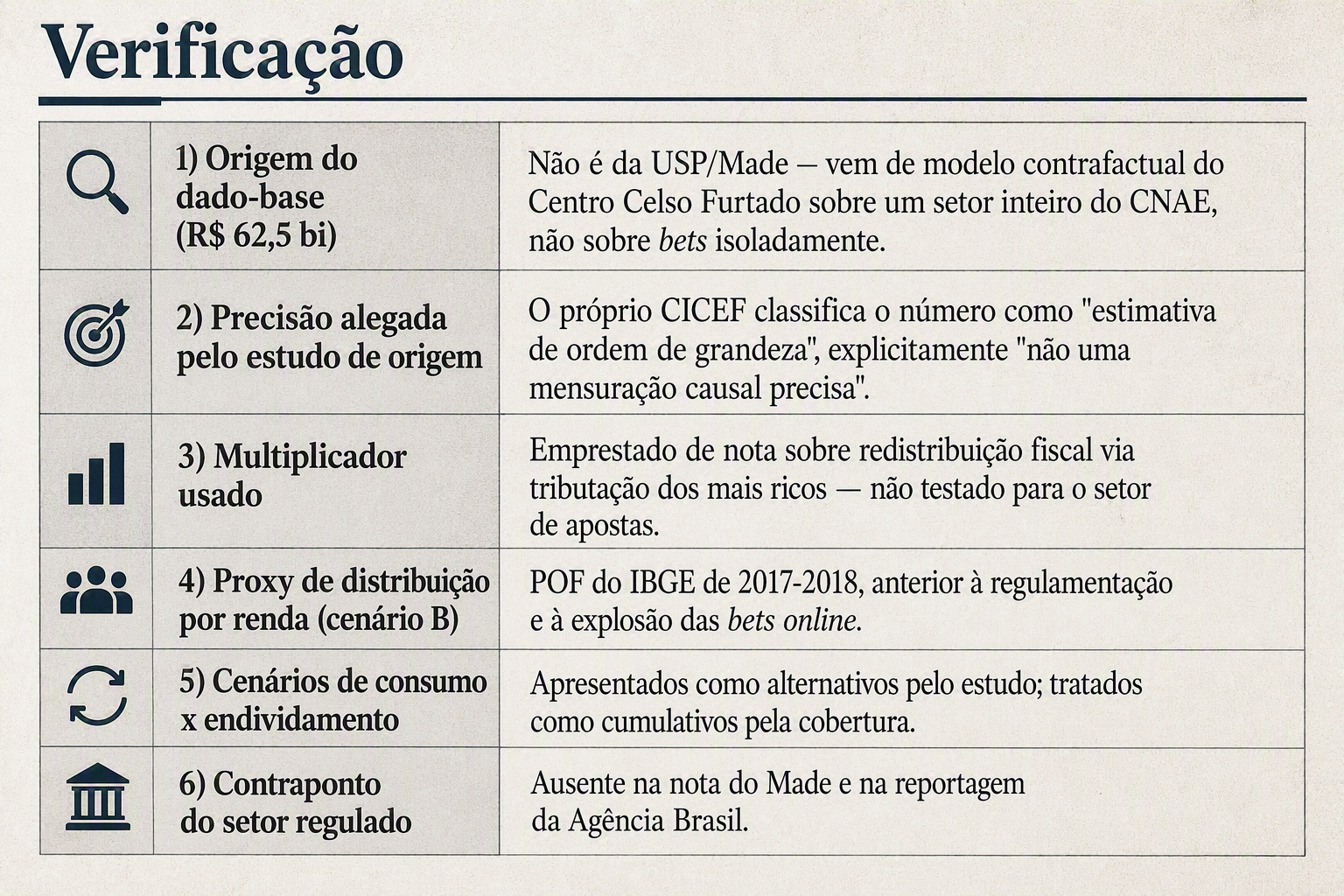
The base figure is not from USP — and it's not specifically about bets.
The entire Made exercise starts from a number that it did not produce: the “R$ 62,5 billion in net transfers from families to businesses in 2025,” attributed to the Celso Furtado Center. Made's own statement admits the source:
“In a recent study, the Celso Furtado Center estimated that, in 2025, there was a net transfer from families to betting platforms […] of approximately R$ 62,5 billion.” — Note from Made/FEA-USP, August 24, 2026
In the original CICEF bulletin, this value does not come from transaction data from the betting houses themselves, but from a counterfactual ARIMA model applied to the volume of transfers via Pix from individuals to legal entities in an entire sector of the CNAE: "Arts, culture, sports and recreation" (Section R) — which includes not only betting, but also museums, libraries, performing arts, sports clubs, gyms and recreation parks. The method projects the trend prior to August 2024 and fully attributes any deviation from the observed series from the regulation onwards, in January 2025, to the entry of betting companies.
CICEF itself is explicit about the scope of this account:
“The counterfactual presented starts from the premise that, in the absence of the bets, the series would have followed the historical trend captured by the ARIMA model. This is an order-of-magnitude estimate of the impact, and not a precise causal measurement.” — Fiscal Bulletin of the Brazilian States, 3rd ed. update, CICEF/Comsefaz
This caveat — crucial to understanding what the number truly represents — does not appear in Made's statement nor in any of the news reports that covered the study.
A multiplier borrowed from a study on another topic.
To transform the R$ 62,5 billion “loss” into an impact on GDP, Made applies marginal propensities to consume by income bracket estimated in its own Economic Policy Note No. 8 — a study on the multiplier effects of taxing the wealthiest to transfer income to the poorest . In the note on betting, there is no multiplier estimate specifically tested for the betting sector; the parameter is imported by analogy, assuming that the money wagered behaves, for the purposes of aggregate effect, as a simple subtraction of household income — without any counterpart in salaries, income taxes (IRPJ/CSLL), advertising, or sponsorships generated by the operators themselves.
The income distribution mixes "who bets" with "how much is lost".
The two scenarios for the distribution of losses across income brackets are based on research on the participation of gamblers (DataSenado 2024 and IPESPE/FEBRABAN 2024) — not on the actual volume lost per bracket. In scenario B, which concentrates the majority of the losses in higher-income families, Made uses a proxy from the IBGE's 2017-2018 POF (Household Budget Survey) for the generic category "games and betting" — research that predates the explosion of online betting in Brazil by almost a decade. The text itself acknowledges this weakness: "because it illustrates a sample referring to the 2017-2018 biennium, the size of this category may be underestimated."
Scenarios presented as alternatives have become cumulative in the coverage.
The note itself treats the hypothesis of a drop in consumption and the hypothesis of increased indebtedness as alternative possibilities —the text calls the second "another possibility" and uses the expression "extreme hypothesis" for the scenario in which all net transfers would be financed by new credit. However, journalistic coverage lines up GDP decline, loss of revenue, increased indebtedness, and income concentration as if they were four simultaneous and cumulative effects of a single phenomenon.
The comparison with the "tariff hike" is rhetorical, not methodological.
The note states that the impact of the tariffs would be "about five times greater" than that of the American tariff hike on Brazilian GDP. This involves comparing an indirect estimate of the consumption effect, built on multiple layers of assumptions, with the estimated impact of a tariff shock of a completely different nature—a comparison that makes headlines, but does not equate to measuring magnitudes of the same type.
No counterpoint from the regulated sector.
Neither the Made article nor the Agência Brasil report consulted operators, the Secretariat of Prizes and Betting (SPA/MF), or entities in the regulated sector. The Agência Brasil text reproduces the Made article almost entirely, including the same examples and the same line of argumentation.
Why does it matter
It's not about denying that the expansion of betting has effects on consumption, indebtedness, and income distribution of Brazilian families—these are legitimate debates. The problem is the way a chain of estimates with multiple layers of uncertainty (a statistical model applied to an entire sector of the CNAE → a multiplier borrowed from another topic → distribution scenarios based on outdated proxies) was presented, by an academic note and the press that replicated it, as a consolidated and precise result: "betting cost Brazil 1,1% of GDP." The research center that originated the baseline number had already warned that it was an "order of magnitude," not a causal measurement.

