
Operation Azzardo: Fintech A55 and state accreditations at the center of the investigation.
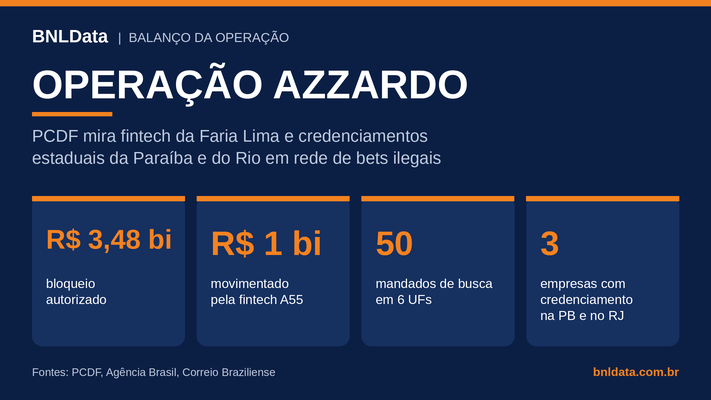
The São Paulo-based fintech A55 Sociedade de Crédito Direto is the main financial target identified so far in Operation Azzardo, launched by the Civil Police of the Federal District (PCDF) on Thursday (5). According to the investigation, the money sent by bettors to websites without federal authorization ended up in more than 100 accounts opened at the institution, which, with companies from the same group, moved around R$ 1 billion.
The investigated network used dozens of shell companies in the Federal District and moved more than R$ 730 million. One of the most sensitive points of the case, however, remains shrouded in silence: the PCDF (Federal District Civil Police) has not revealed the names of the three companies that obtained accreditation in the state lotteries of Paraíba and Rio de Janeiro and that are at the center of the investigation.
Fintech at the heart of the flow
A55 is headquartered on Avenida Brigadeiro Faria Lima and is authorized by the Central Bank to operate as a direct credit company (SCD). According to the PCDF (Federal District Civil Police), it was the recipient of several Pix payments generated by the investigated websites. Part of the funds then went to investigated companies and platforms without federal authorization, including conversion into crypto assets.
"This financial institution, two companies from the same group, and their directors are the targets of the search and seizure warrants executed in today's operation," reported the PCDF (Federal District Civil Police). The freeze only affects the company's own assets and protects the accounts of clients who are not under investigation.
The institution was already on the regulator's radar. On July 30, 2026, the Central Bank had announced its intention to cancel its operating license. In March, Pagsmile even announced the purchase of 49% of A55, but the deal was terminated when RB Holding completed the acquisition of the fintech. In a statement, Pagsmile stated that it has no shareholding or operational link with A55.
According to Revista Fórum, A55 was the fintech company that alerted COAF (the Brazilian Financial Intelligence Unit) about the financial transactions of lawyer Willer Tomaz, a case followed by BNLData. Contacted by the press, A55 had not yet responded at the time of this text's last update.
State accreditations as a veneer
The investigation targets three companies that obtained authorizations from lotteries in Paraíba and Rio de Janeiro. The PCDF (Federal District Civil Police) described the role of each company, but did not release their names:
⇒ The first is managed by the same group that controls one of the main resource concentrators of the scheme. It has had frequent changes of partners and attorneys and maintained most of its accounts in institutions not accredited by the state lottery. Four of these accounts were opened even before the company obtained authorization;
⇒ The second is a consortium authorized only 15 days after its formation. Among its members were companies identified as recipients of money from victims of fraud and which transacted with shell companies in Sobradinho and Ceilândia;
⇒ The third one appears in the financial reports as the final concentrator of the amounts collected by Pix accounts.
According to the PCDF (Federal District Civil Police), state accreditations did not replace the federal authorization required for fixed-odds betting, and none of the investigated websites were listed among those authorized. The authorizations ceased to be effective after the transition period of Provisional Measure No. 1.394/2026.
The mere 15-day period between the formation of the consortium and its authorization is the detail that most requires explanation from the state lotteries involved. Lotep and Loterj must clarify which accredited companies are the target of the operation and what criteria were used in analyzing the applications.
The operation in numbers
The investigation began five months ago, based on communications from the Prizes and Betting Secretariat of the Ministry of Finance (SPA/MF), even before the ban on betting. The websites, all without federal authorization, were advertised on social media and appeared in Google searches. Payments via Pix (Brazil's instant payment system) ended up in companies with no declared connection to betting, such as a psychosocial assistance clinic and a tarot card shop in Sobradinho.
|
Item |
Nut |
| Police officers mobilized | approximately 200, from six states of the Federation |
| Search and seizure warrants | 50 (24 in the Federal District) |
| States beyond the Federal District | SP, GO, PR, CE and RN |
| Blocking authorized | up to R$ 3,483 billion |
| Targets of the blockade | 64 individuals and 120 legal entities |
| CNPJs and registrations suspended | 100 companies and individual entrepreneurs |
| Secrets set aside | 82 individuals and 83 legal entities |
| New accounts prohibited | 90 days |
| Cryptocurrencies blocked | R $ 280 thousand |
| prisons | none at this stage |
The shell companies were opened between February and July 2026, with identical share capital and addresses in Sobradinho, Sobradinho II, and Ceilândia. In a single batch in Ceilândia, ten of them listed the same phone number. Vulnerable individuals received R$ 200 for providing their data.
Those under investigation may face charges of operating an unauthorized lottery, fraud through electronic scams, forgery, money laundering, and organized crime. The next steps are to identify the true owners of the companies and trace the final destination of the money.
The case shows that the illegal market was already operating on a large scale before Provisional Measure 1.394 and that it was the oversight structure created by the regulation, through the SPA (Special Secretariat for the Promotion of Gambling), that allowed it to be identified. Gambling is either legal or illegal; not gambling is impossible.

