
Ban on betting opens the floodgates: nearly 300 new suspicious websites invade Brazil every day.
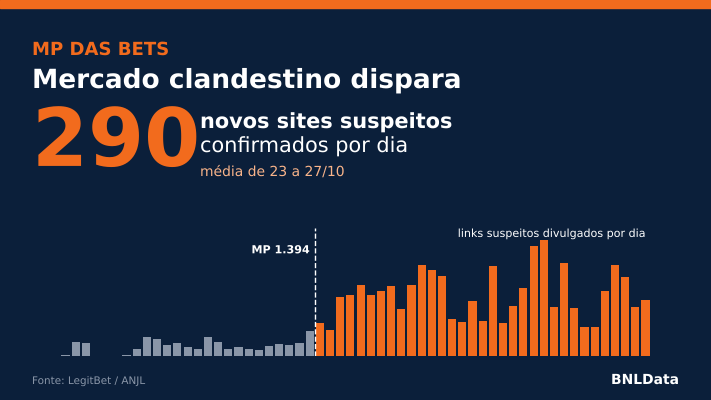
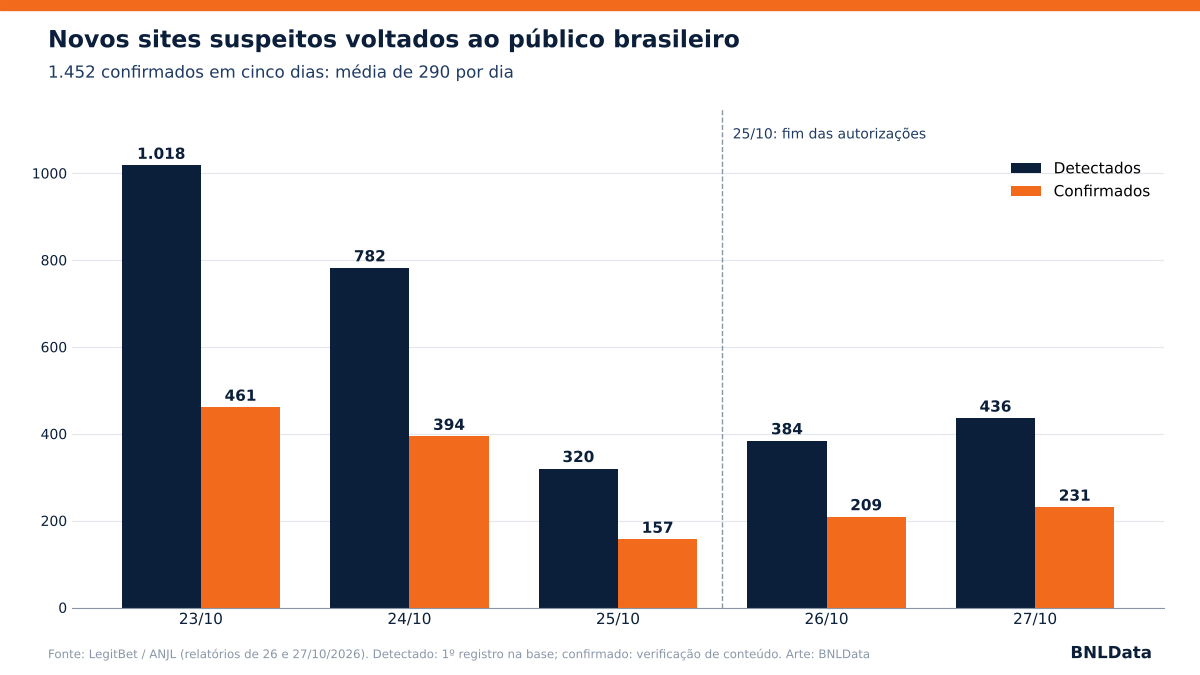
The government celebrates the “end of betting.” The black market celebrates even more. In the first two days after October 25th, the date on which the authorizations for betting houses expired, the LegitBet monitoring system detected 820 new suspicious websites targeting the Brazilian public and confirmed 440 of them. On October 27th alone, 436 were detected and 231 confirmed, almost ten new platforms per hour, from dawn till dusk.
The figures are from two daily reports produced by LegitBet and shared with BNLData by the National Association of Games and Lotteries (ANJL). They dismantle, with data, the promise that Provisional Measure No. 1.394/2026, published on September 25th, would end gambling in the country. It didn't. It only removed from the game those who paid taxes, complied with rules, and could be audited.
A domain factory
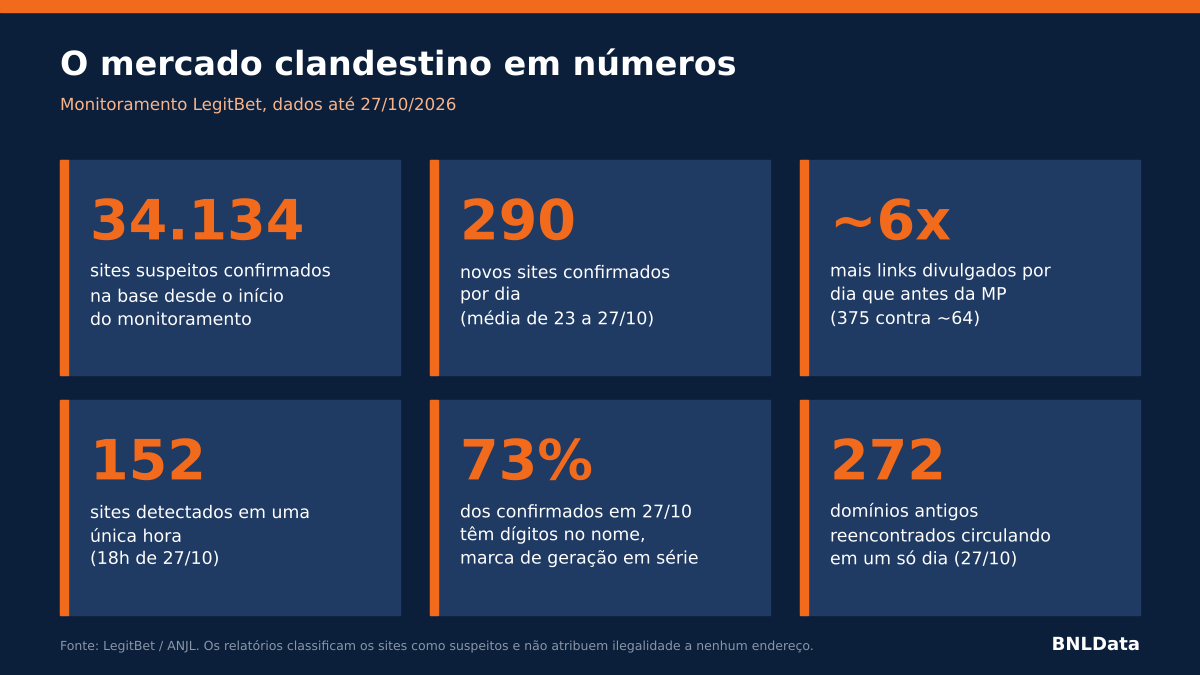
Since the start of monitoring, LegitBet's database has accumulated 60.477 detected suspicious websites, of which 34.134 (56%) were confirmed by content verification. Between October 23 and 27, a period in which the system's coverage had already stabilized, 1.452 new websites were confirmed, an average of 290 per day.
The profile of these addresses reveals an industrial scale. On October 27th, 73% of the confirmed websites had digits in their name, a typical pattern for mass-generated domains. The same name appeared in 11 different domains, varying only in number, letter, or ending. Another family of nine addresses, numbered from 0 to 9, was registered between 17:24 PM and 17:25 PM. At 18:40 PM, dozens of websites from the same network entered the database in the same minute. In the 18 PM time slot, there were 152 detections in a single hour.
And it's not just what's new. On the same day, the monitored sources rediscovered 272 domains that were already in the database, meaning old addresses that are still circulating. On October 26th, there were 285.
The information exploded after the MP
The most telling data lies outside the website count. LegitBet also tracks how many suspicious links are shared on the monitored channels. Between September 1st and 23rd, before the Provisional Measure, the average was around 64 links per day, with several days below 50.
The turnaround began on September 24th, the day before the measure was enacted, when Lula's decision to ban betting was already public. Since then, the indicator has not returned to its previous level. It reached 777 links on October 17th. In the seven days leading up to October 26th, the average was 375 links per day, almost six times the pre-MP level. On October 27th, there were 374.
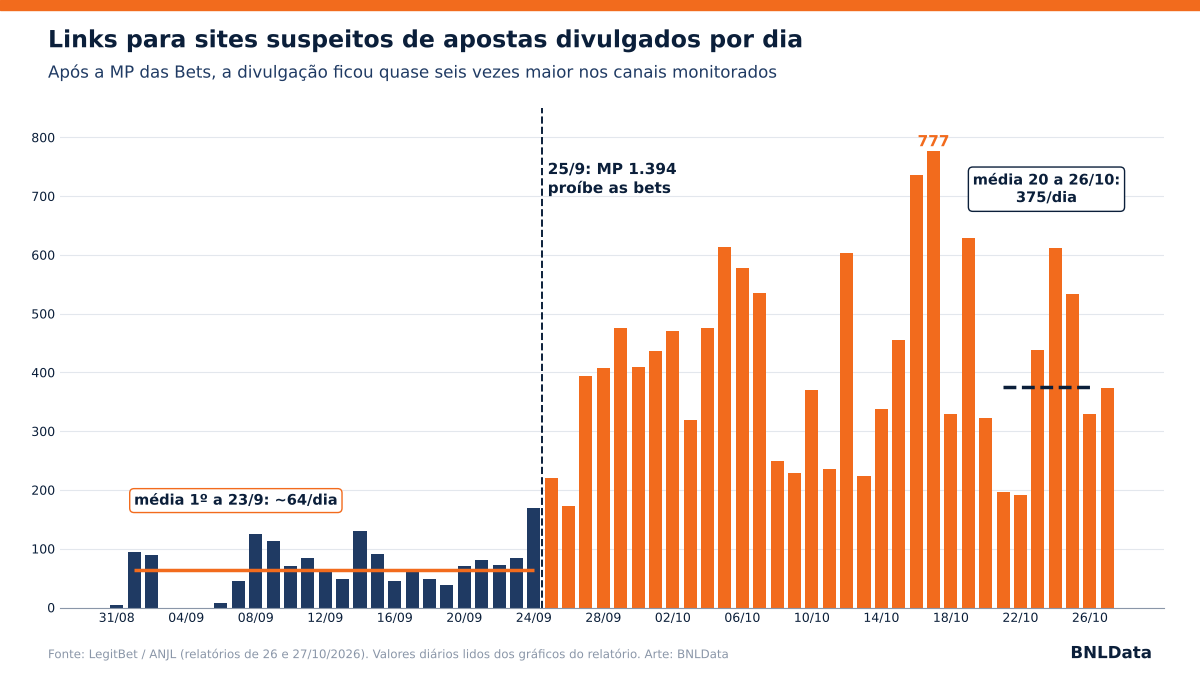
The interpretation is simple: with the departure of authorized companies, clandestine advertising has taken over the space. Those who previously saw advertisements from regulated operators now receive, via Telegram, Kwai, or aggregator websites, links to platforms with no known CNPJ (Brazilian tax ID), no address, and no responsible party.
Imitating brands and the word "official"
Among the websites confirmed over the two days are domains that reproduce the names of brands that operated legally in Brazil until the Provisional Measure, variations of the names of betting houses that had authorization from the Secretariat of Prizes and Betting (SPA/MF), as well as addresses that use terms like "official" and "Brazil" to appear legitimate. There are even domains that piggyback on the names of large technology companies. There is no indication of any link between these brands and the websites; the pattern is one of exploiting the vacuum left by the operators that left the market.
For the gambler, the trap is perfect. He looks for a betting site he knows, finds a similar address, and deposits the money.
The bait: PIX, CPF, and a R$1 million bonus.
The elements found on the pages show how the black market presents itself to Brazilians. Payment via PIX (Brazilian instant payment system), registration with CPF (Brazilian taxpayer ID) and cell phone number, values in reais (Brazilian currency), free spins, and games from the "Fortune" family, the popular Tigrinho, appear frequently. Deposit bonuses, a practice prohibited in the regulated market, are the norm. There are promises of daily bonuses of R$ 3,88 and "up to R$ 1 million per invitation," a mechanism that transforms the bettor into a recruiter of new players.
None of this has the protections that regulation required of authorized companies: identity and age verification, responsible gambling tools, self-exclusion, limits, and payments only from accounts in the bettor's name. The ban protected no one. It removed the protection that existed.
The use of PIX also raises an uncomfortable question for the Central Bank and the Ministry of Finance: if payments continue to pass through the Brazilian financial system, who is closing those doors?
The account that doesn't add up
For comparison, the list of domains from Anatel imported by LegitBet on September 30th had 1.881 addresses. Of these, 1.033 were new to the system. The database of suspicious websites confirmed by private monitoring already exceeds 34, and is growing by an average of almost 300 per day.
The government argues that ending the illegal betting system would cause a "change of hands" of money, from betting to consumption. Reports show a different shift: from the regulated market, which collected taxes and financed legitimate beneficiaries such as sports, public safety, and health, to platforms that pay nothing, protect no one, and are accountable to no one. Even before the Provisional Measure, after 22 months of regulation, the illegal market still accounted for more than 40% of bets. Now, it is alone.
As Magnho José, president of the Brazilian Institute of Legal Gaming (IJL), often repeats: "Gambling is either legal or illegal; not gambling is impossible."
MP 1.394 blocks the Congressional agenda on November 9th and will expire on March 4th, 2027 if it is not voted on. Lawsuits against the measure await a decision from Minister Luiz Fux at the Supreme Federal Court (STF). While Brasília decides, the black market doesn't wait: it opens, on average, a new door every five minutes.
How to read numbers
⇒ Detected: first record of the domain in the monitoring database. Confirmed: content verification found the characteristics tracked by the system on the page.
⇒ Since October 5th, only websites targeting the Brazilian audience are considered confirmed. On October 27th, another 82 websites with the same characteristics, targeting other countries, were excluded; on October 26th, 61 were excluded.
⇒ The confirmation of October 26th and 27th uses a revised, more restrictive verification: according to the previous criteria, there would be 278 and 336 confirmed cases, not 209 and 231.
⇒ Monitoring coverage was expanded between September 24 and 28, and again on October 21 and 22; the detection peaks on those days (6.722 and 6.799 on October 21 and 22) do not measure website creation and were not used as a growth indicator in this report.
⇒ Addresses of authorized operators, within their official reserved domain, and the Anatel list are not included in the counts.
⇒ The reports classify the websites as suspicious and do not attribute illegality, authorship, or responsibility to any address; this analysis is the responsibility of the competent authorities. ⇒ Therefore, BNLData does not reproduce the listed domains.
⇒ The average number of links before the Provisional Measure was calculated by BNLData from the daily values in the report's graph (September 1st to 23rd).

