
SPA Secretary says Government has already shut down nearly 23 illegal betting operations and details measures to combat them.
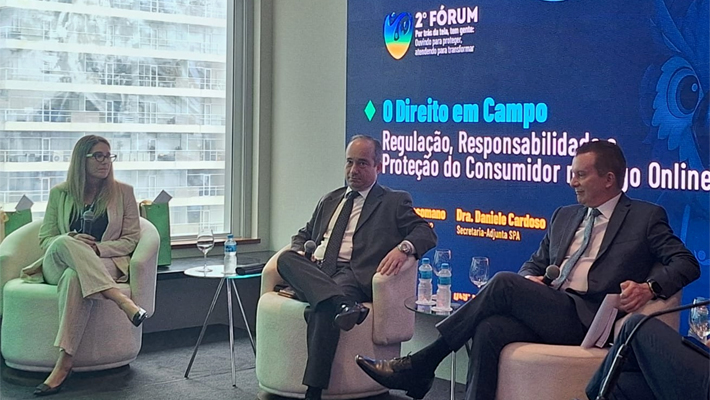
The Deputy Secretary of the Prizes and Betting Secretariat of the Ministry of Finance (SPA-MF), Daniele Cardoso, updated the number of illegal betting sites taken down with Anatel, with numbers that currently reach around 23 thousand. The news was announced this Thursday (30), during the 2nd Forum on Awareness and Protection of Online Game Bettors, promoted by the Galerabet betting platform, at the Hilton Morumbi Hotel, in São Paulo.
“When we talk about illegal gambling, it’s important to say that we have fronts in this fight. We have a technical cooperation agreement with Anatel [for taking down clandestine betting sites], and when we identify an illegal site, whether because we receive complaints, because there is a specific area that does this monitoring, or because we have a technical cooperation agreement with Conar, which also reports to us, we take down these sites. And we are already at almost 23 sites taken down,” Cardoso highlighted during his participation in the third panel of the day, which addressed consumer responsibility and protection in online gambling.
In her view, this movement, along with specific regulations for payment methods, ranging from restrictions on forms like cryptocurrencies to the determination that payment facilitation companies cannot offer courses to illegal websites, has helped to close the net and should prevent the creation of new irregular betting sites.
The move, approved by the Central Bank to regulate institutions that facilitate payments for betting, led to the publication of a new ordinance with guidelines for these companies in 2025 (Ordinance SPA/MF No. 566). “They [financial institutions (FIs) and payment institutions (PIs), as well as payment arrangement providers] are required to monitor, supervise, and, if they notice any suspicious activity, they need to inform us. We started receiving these reports and from there we began to analyze them. We have already identified and started reporting to the Central Bank, the Federal Police, and the Federal Revenue Service. In parallel, we are also moving towards public disclosure,” he pointed out.
Another important point highlighted was the new measures to protect the health of gamblers, which should soon be proposed by the Interministerial Working Group (GTI) on Mental Health and Prevention and Reduction of Harm from Problem Gambling. "We are close to launching a centralized self-exclusion platform. Through this, citizens will be able to exclude themselves from all platforms regulated by the SPA in one fell swoop," he revealed.
During the forum, there were also discussions about gambling addiction within the context of psychology and the role of the State in preventing gambling-related disorders. Galerabet's CEO, Marcos Sabiá, celebrated the meeting and reaffirmed his hope that the reflections will positively impact the market.
“Galerabet always positions itself as a leader and at the forefront, addressing issues that go beyond the gaming market and impact the whole of society. Combating the harmful effects of gambling disorder, controlling advertising, and promoting a healthy industry are commitments not only of the company, but of the entire regulated sector in Brazil. We want to demonstrate that this is an industry committed to the country, to ethical values, and to building a productive path for society. After decades relegated to illegality, this activity needs to deconstruct the stigma and reaffirm its commitment to legality and responsible gaming. Today, the sector generates billions in taxes and hundreds of thousands of jobs, demonstrating its economic relevance,” Sabiá highlighted.
Below are the main topics discussed throughout the panels:
Panel 1 – The Mind at Play
With the theme “Psychological Aspects of Gambling Addiction and the Challenges of Clinical Care,” the first panel brought together Dr. André Negrão, a specialist psychiatrist from the Hospital das Clínicas in São Paulo, Dr. Rafael Ávila, a clinical psychologist, and Dr. Marco Paes, a lawyer and Director of Ombudsman at Galerabet. The panel focused on gambling addiction as a mental health condition that requires support, not punishment. The aim was to discuss the psychological impact of gambling and the clinical and institutional mechanisms for prevention and treatment, focusing on the human dimension of the gambler and emphasizing the role of care, listening, and empathy as fundamental elements of responsible gambling policy.
Psychiatrist André Negrão commented on the importance of psychological support for gamblers suffering from gambling-related disorders, especially during periods of escalating tension. “Drawing from the same source as chemical dependencies and gambling, for a long time before the 'house falls down' there is a silence. The initial social cost is low, but when the problem becomes apparent, despair sets in. The person loses money and thinks they will be able to recover it, so they resort to successive loans. It is important to work on how this denial occurs and how to recognize this condition,” he stated.
Clinical psychologist Rafael Ávila highlighted how addiction also affects the people around the gambler who suffers from gambling disorders.
“Studies show that each person with gambling disorder affects six others. This is called passive gambling, where the lives of those around them are affected by the addiction of someone close. Whether it's loss of income, broken family ties, or potential aggression during withdrawal. It's never an individual problem: it causes problems for the family; the person may borrow money, come into contact with loan sharks. And it generates damage all around, including damage to the reputation of gambling and regulation itself. It's something that reverberates throughout society. So it's very interesting to bring into these discussions the people who are around and affected by gambling disorder, including providing support,” added Rafael.
Meanwhile, Marco Paes, director of customer service at Galerabet, highlighted the dynamics of the strategic customer service department as a bridge between the bettor and customer care, based on the pursuit of transforming customer service into an instrument of prevention and emotional support. “At Galerabet's customer service department, we have always aimed to make it more humanized. We want everything to be resolved on the first call. We expect that first call to be brought to the customer service department and not just as a simple number. The customer service department is one that welcomes and resolves issues. That's what we strive for at Galerabet, and we've noticed it's already working.”
Panel 2 – From Digital to Public Policy
The second panel of the day, entitled “The Role of the State in Preventing Gambling Addiction and Promoting Responsible Gambling,” featured lawyers Fernanda Meirelles, Partner at FAS Advogados, and Francisco Manssur, who was a special advisor to the Executive Secretary of the Ministry of Finance and participated in the drafting and implementation of regulations for sports betting in Brazil, as well as Ana Bárbara Teixeira, director of Abrajogo. The discussions highlighted responsible gambling as a shared commitment between the State, companies, and society, reinforcing how effective public policies, supported by regulation, oversight, and prevention, can guarantee a balanced environment between economic freedom and consumer protection. Combating illegal betting operations was also a key topic.
“When a player is in the illegal market, everything is lost, including the bettor's data and metrics. And it is only with this data, about the player's income and how much they bet, for example, that it is possible to protect them. Prevention of the illegal market is fundamental, without a doubt, but, in addition, we also have to prevent bettors from getting there,” reflected Fernanda Meirelles.
Francisco Manssur pointed out that addressing the main problems also focuses on combating the illegal market, and explained the main strategies for fighting illegality in the sector.
“No matter how well public policy is applied, and no matter how much goodwill the regulated sector has in following the rules, we will not be able to address the central issues if we do not confront the illegal market. What we need to do is put the policies into practice, and I see four main ways to combat illegality: coercing the advertising of illegal bets, prohibiting platform providers from working with clandestine bets, taking down the illegal sites themselves, even though they always end up reappearing, and blocking the action of illegal bets through payment methods. I believe this last one is the most important,” he highlighted.
Abrajogo's director, Ana Bárbara Teixeira, emphasized the importance of obtaining data to guide the best policies. "We are trying, together with the operators, to conduct a study that will allow us to determine the actual amount that players spend on the platforms. We need to understand, with the data we have, the user profile and how to best address this. The data helps us understand where the problem lies and where it doesn't," she stated.
Panel 3 – Law in the Field
In the third panel, in addition to the Deputy Secretary of the Secretariat of Prizes and Betting of the Ministry of Finance (SPA-MF), Daniele Cardoso, Federal Deputy Celso Russomanno (Republicanos-SP) and the Executive Director of Procon-SP, Luís Orsatti, also participated. The theme was “Regulation, Responsibility and Consumer Protection in Online Gambling,” highlighting the essential role of consumer law in balancing the market and protecting citizens in an increasingly sophisticated digital environment.
The executive director of Procon-SP highlighted the agency's initial impressions of the first 10 months since the start of the regulated market. "At Procon-SP, we've seen an average increase of 40% (compared to last year) in consumer complaints on the platforms. It's a small number, but it's significant and has numerous explanations, as it's a new segment that experienced a significant legislative gap," he pointed out.
Federal Deputy Celso Russomanno reinforced the importance of regulating betting from a consumer rights perspective. “Gambling is a service and it must have parameters: transparency, ensuring consumers are aware of what is being offered, and that promises made to consumers are kept. We must be concerned about consumers in general, and in gambling as well,” he pointed out.
“[The betting sites] have to be transparent in this process, because if they aren't, even though they are legal, they will also suffer the penalties of the law. Credibility comes through advertising, publicity, and transparency. And each betting site has to take care of that. When one betting site falls into disrepute, it has that effect on the others as well,” he added.

