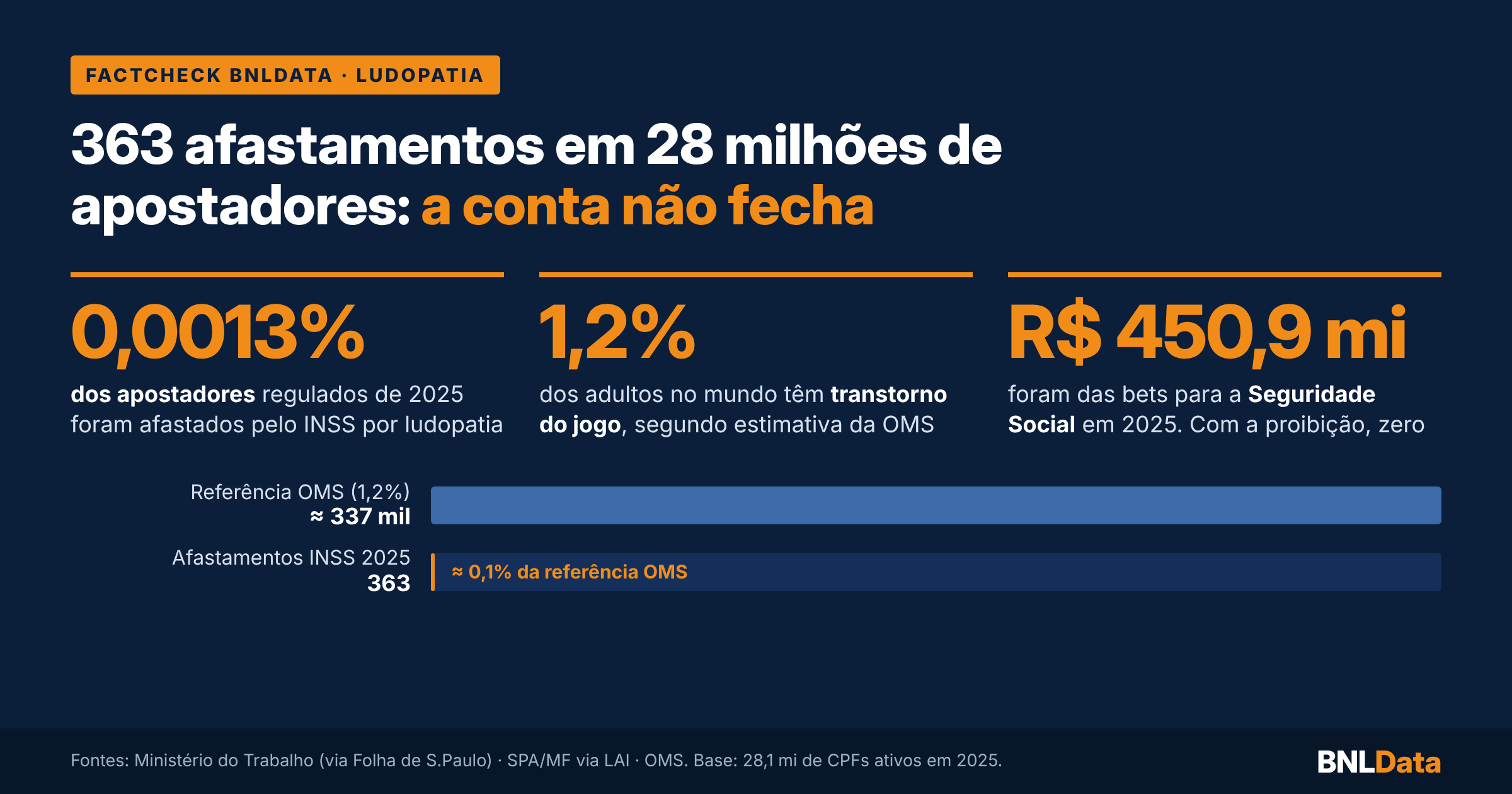
363 disqualifications among 28 million bettors: Folha's numbers do not support the argument for prohibition.

Folha de S.Paulo published a report on Tuesday (20) according to which the regulation of bets caused absences from work due to gambling addiction to increase by more than 400% in two years. The survey is from the Subsecretariat of Statistics and Labor Studies, of the Ministry of Labor, and was previewed to the newspaper. According to the data, the number of insured persons who received temporary disability benefits from INSS due to gambling addiction went from 67 in 2023 to 136 in 2024 and reached 363 in 2025.
The percentage is impressive, but the base is very small. When the numbers are put into perspective, the conclusion is different.
The true size of the problem
Data obtained by BNLData via the Access to Information Law from the Secretariat of Prizes and Bets of the Ministry of Finance (SPA/MF) shows that the regulated market had 28.128.172 unique CPF numbers with active registration in 2025. In the first half of 2026, there were 30.895.934.
The 363 withdrawals in 2025 represent 0,0013% of the number of bettors in that year, or about one case for every 77 bettors.
According to the World Health Organization (WHO), the standardized global estimate of harm caused by gambling is still limited. Available surveys indicate, however, that approximately 1,2% of the world's adult population has some form of gambling disorder. If this rate were applied only to the 28,1 million active gamblers in 2025, Brazil would have more than 337 people with the disorder. The recorded absences from work represent about 0,1% of this number.
The two measures are not equivalent. Social security leave does not measure the prevalence of the disorder because it only includes formal workers and INSS (Brazilian National Institute of Social Security) beneficiaries who have undergone a medical examination. Even so, the comparison shows that the numbers presented by Folha, although they seem high in percentage terms, are far below what international benchmarks would suggest.
The author herself urges caution.
Folha reports that Paula Montagner, the undersecretary responsible for the study, acknowledges that there is insufficient data to confirm that the increase in layoffs was caused by gambling addiction. The study itself states that the initial numbers need to be treated with great caution because they represent small groups with access to the benefit.
Even with these reservations, the study concludes that legalization shows a "close association" with an increase in gambling addiction. The undersecretary also defends restricting gambling as a mental health measure. A survey that admits it does not have sufficient data to establish causality, but arrives at a public policy recommendation, was released a few days before the second round of elections by a government department that issued Provisional Measure No. 1.394/2026.
The chronology that the report ignores
The report states that betting was "allowed" in December 2023. In fact, fixed-odds betting was authorized by Law No. 13.756/2018 and operated for five years without regulation, oversight, or advertising rules. Law No. 14.790/2023 did not legalize betting. It imposed rules on a market that already existed.
Folha also says that, with the regulation, betting houses “were able to expand advertising.” The opposite occurred. Advertising was free until the regulation and became restricted with the SPA/MF ordinances. Furthermore, the regulated market only began operating on January 1, 2025. Therefore, 2024, which the text calls the first year of the rules' validity, was in practice a transition period.
The increase in sick leave may reflect not only more cases, but also more diagnoses. Gambling addiction has gained visibility, the Brazilian public health system (SUS) has created a specific telehealth service, and more workers have started seeking treatment and expert assessment. A market emerging from the shadows also makes its effects more visible.
With regulation, there were resources for treatment.
The most important point is that only the regulated market generated resources to address the problem described in the report. Of the contribution on the GGR (General Remuneration Plan), which was 12% in 2025 and increased to 13% in 2026, approximately 10% of the amount transferred to legal beneficiaries went to Social Security, which finances pensions and public health. Another 1% went to the Ministry of Health.
Spreadsheets from SPA/MF obtained by BNLData via the Access to Information Law show that, in 2025, Social Security received R$ 450,9 million from betting. This is the same year in which the INSS (National Institute of Social Security) granted the 363 disability benefits that Folha attributes to gambling addiction. In other words, the regulated sector was financing the very social security system that paid these benefits.
The Ministry of Health received R$ 44,9 million in 2025 and another R$ 24,19 million in the first half of 2026, totaling approximately R$ 69 million in 18 months. This money went to the Care for People with Gambling-Related Problems program, which includes the SUS (Brazilian Public Health System) telehealth service. In total, over 17 months of effective collection, the contribution on the GGR (Gambling Risk Management) yielded R$ 6,64 billion to the legal beneficiaries.
With the ban, this flow ended. According to a projection by BNLData, legal beneficiaries could lose up to R$ 18 billion by the end of the concessions in 2029. However, gamblers with gambling disorders have not ceased to exist. More than 40% of the market already operated illegally before the Provisional Measure, and with the ban, this segment became the only available market. Illegal platforms do not verify age, do not offer self-exclusion, do not block beneficiaries of social programs, and do not collect a single cent for the SUS (Brazilian public healthcare system) or the INSS (Brazilian social security system).
The result is that the state continues to bear the costs of disability benefits, expert assessments, treatment, and psychosocial care, but without the revenue that the regulated sector guaranteed.
Regularization is the only way to protect it.
Only a regulated and supervised market gives the government the means to identify vulnerable gamblers, impose limits, and fund public policies to reduce the negative externalities of gambling. With prohibition, the state is left only with the burden generated by illegal platforms.