
Medical care for gambling addiction grows by 104% in the country.
The demand for medical and psychological care related to online gambling addiction grew by 104% in Brazil between January 2018 and May 2025. The Ministry of Health recorded 10.553 cases related to pathological gambling and gambling addiction in the Unified Health System (SUS) during that period. Experts warn that the real number is even higher, given that the ministry acknowledges underreporting in the records.
The National Survey on Alcohol and Drugs (LENAD III) estimates that 7,3% of the Brazilian population, equivalent to 10,9 million people, already exhibit risky or problematic gambling patterns. Approximately 1,4 million have developed gambling-related addiction, according to data collected and published by the newspaper O Globo.
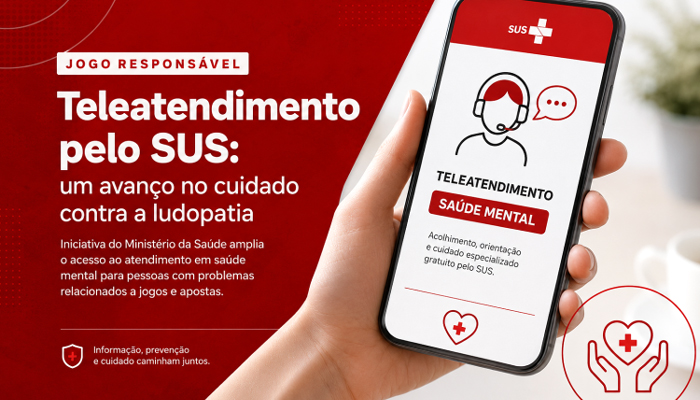
This scenario spurred an expansion of public health services. In March of this year, the Ministry of Health created a specific telehealth strategy for people with problems related to gambling and betting, with an initial capacity of 600 consultations per month. Due to high demand, the service was expanded to up to 100 telehealth consultations per month. Since the end of March, 27.703 people have registered to receive the service, according to ministry data.
Since December 2025, when the federal government launched a tool for self-exclusion from gambling platforms, more than 1 million people have signed up for the service, according to information from Agência Brasil.
Integrated treatment
Experts argue that the most effective treatment for gambling disorder, the official name for gambling addiction, goes beyond focusing exclusively on the act of gambling. The most up-to-date approach combines psychiatric care, financial support, family support, and social attention in a single therapeutic plan.
Psychiatrist Rodrigo Machado, a researcher in behavioral addictions at the University of São Paulo (USP) and co-coordinator of the Elibrè Program for Games & Betting, describes the common pattern among patients: the search for help begins with a psychologist, progresses to a psychiatrist, and, in many cases, the patient themselves tries to reorganize their finances while the family acts independently. Each front operates in isolation.
"The vast majority of treatment programs for gambling disorder still focus almost exclusively on gambling behavior, that is, on only one facet of the illness. But what science has seen is that the process of becoming ill is very complex and multifaceted," said Machado.
Dr. Ary Ribeiro, executive director of Elibrè, a mental health institution located in Cotia, in Greater São Paulo, points to another impact of the disorder: each person with the condition affects, on average and by estimate, at least six people around them. “The fragmentation of care is a critical problem in Brazil and crosses practically all health specialties. In mental health, however, it takes on an even greater proportion because illness is never an individual occurrence,” stated Ribeiro.
The CEO adds that patients often only seek help when the condition is in an advanced stage. “When we add these factors together, treatment becomes more complicated, the risk of relapse increases, and the illness can extend to the support network itself. It is precisely this chain that an integrated model interrupts,” he concluded.
Shortage of specialists and services
A survey by the Brazilian Federal Court of Accounts (TCU), released in 2025 on the impact of gambling on health and the economy, identified that the Psychosocial Care Network (RAPS) faces a lack of specialized professionals and physical space for treatment. The report pointed out: “There are problems in the coordination between the responsible areas, a lack of specific indicators to monitor the problem, and few awareness campaigns about the risks of addiction. In addition, the number of cases registered as pathological gambling may be underestimated, and actions to detect cases of addiction early are limited.”
Gambling disorder has been classified as a behavioral addiction by the Diagnostic and Statistical Manual of Mental Disorders (DSM-5) since 2013. The World Health Organization (WHO) also recognizes the condition in the 11th International Classification of Diseases (ICD-11).
How to identify the disorder
In clinical practice, the central element for identifying the disorder is the loss of control. Psychiatrist Emílio Tazinaffo, a researcher in behavioral addictions at USP (University of São Paulo) and co-coordinator of the Elibrè Program for Games & Betting, describes three questions that screen for the illness with almost 100% sensitivity:
⇒ If the individual uses the game to disconnect from or escape problems;
⇒ If you keep chasing your losses, betting to recover what you've lost;
⇒ Losing control; like planning to bet R$10 and ending up spending R$200.
"If a person has these three symptoms, the chance of them being ill is almost 100%," Tazinaffo stated.
The groups most susceptible to the disorder include young people with still-developing brains, people from lower socioeconomic classes, and individuals with other psychiatric disorders. Tazinaffo emphasizes, however, that this profile is not exclusive: "A very sad phenomenon of gambling disorders that we see in clinical practice is that many parents, who are very responsible and had no other addictions, started gambling carelessly and then developed the illness."
The role of digital platforms
Online platforms have a much higher addictive potential than bets placed in physical establishments. Among users of digital platforms, 66,8% exhibit risky or problematic patterns, compared to 26,8% in other betting modalities, according to LENAD III data.
The mechanism is linked to unpredictability. “Whenever we think about betting, we think that the bettor becomes very fixated on winning. Obviously, winning is very important. But, more than just winning, they become dependent on the unpredictability of the process. Betting is an extremely unpredictable activity, and our brain is more dependent on the unpredictability of the outcome than on the outcome itself,” explained Tazinaffo.
The brain's reward system releases neurotransmitters linked to the expectation of pleasure, especially dopamine. The speed between the bet, the expectation, and the result reinforces repetitive behavior. Even in the face of successive losses, the brain continues to anticipate the possibility of future gain, according to an analysis by psychiatrist Analice de Paula Gigliotti, a professor at PUC-Rio, published in an article in The Conversation.
In July of this year, the Ministry of Health launched the National Campaign for the Prevention of Harm from Online Gambling, broadcast on television, radio, and social media. The initiative warns about the risks of problematic use of gambling platforms and promotes the mental health services of the SUS (Brazilian Public Health System) for gamblers and affected family members.

