
A USP economist dismantles in the Supreme Court the arguments that bets indebt families, reduce GDP, and empty supermarkets.

The afternoon session of the public hearing convened by Minister Luiz Fux, rapporteur of ADI 8027 and other actions against Provisional Measure No. 1.394/2026, had on Tuesday (3) the technical counterpoint that was missing from the government's speeches. Economist Erick Brasil, PhD and Master in Economics from USP and Director of Regulation and Public Policies at LCA Consultoria Econômica, used public data to contest the three main arguments used to justify the ban on bets: household debt, GDP loss and increased consumption in supermarkets.
Erick Brasil spoke on behalf of the Brazilian Association for Economic Freedom (ABLE) and also used time granted by the International Gaming Association – AIGAMING. He has been studying the sector since 2022 and has coordinated a study group on LCA betting since 2023. Right at the beginning, he warned that he would address claims without a basis in data that have been repeated since 2024. “We can call these points errors, intellectual dishonesty, often even fake news. But more important than labeling them is bringing public data,” he stated.
Less than 0,5% of consumption
The first target was the association between betting and the debt crisis. According to the Ministry of Finance, the gross revenue (GGR) of authorized operators in 2025, the first year of the regulated market, was R$ 37 billion. This value is the difference between what was wagered and what was returned in prizes, that is, the effective spending of bettors. Total household consumption in the GDP was approximately R$ 8 trillion.
"How can an expense that represents less than 0,5% of household consumption be elevated to the status of the main factor in a systemic crisis of default and indebtedness?", he questioned.
To put this into perspective, the economist compared the amount to other expenses:
Streaming : Families spent twice as much as they did on gambling.
⇒ Cell phones and accessories: R$ 152 billion.
⇒ Interest: nearly R$700 billion, about 19 times the amount spent on bets.
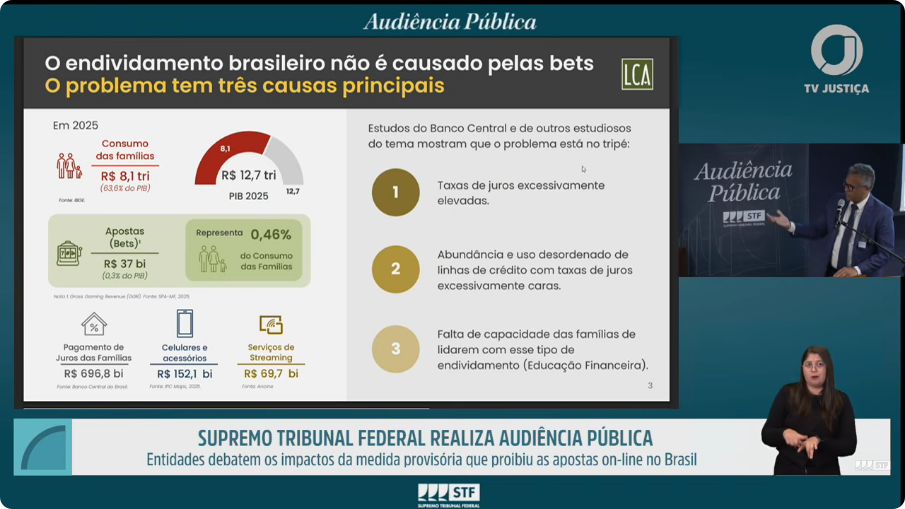
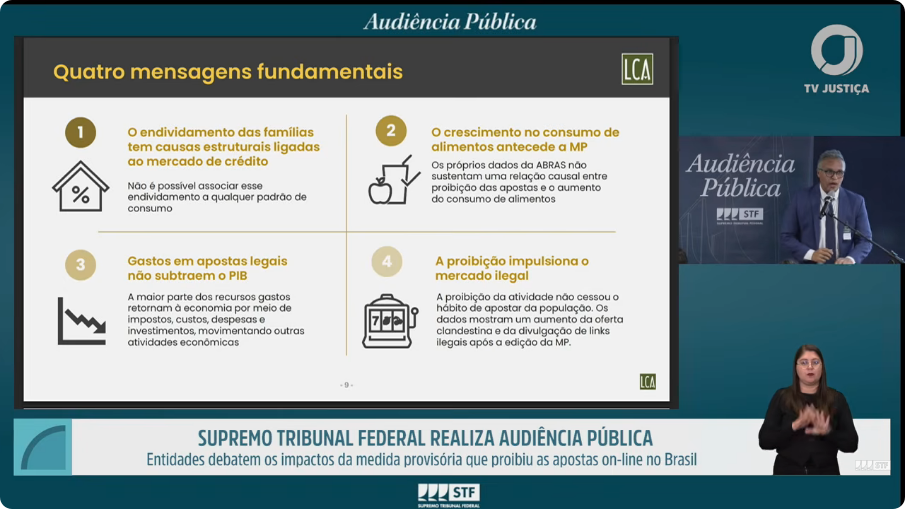
Erick Brasil did not deny the problem. He acknowledged that there are individual cases of default linked to gambling, as occurs with alcohol and other compulsive consumption, and that this is a public health issue. But he recalled that studies by the Central Bank and academia point to a structural tripod for Brazilian indebtedness: very high interest rates, easy and expensive credit, and low financial literacy, especially among low-income individuals. "That's what will cause us to have Desenrola one, Desenrola two, Desenrola three, Desenrola four, Desenrola five," he quipped.
"Mathematical impossibility"
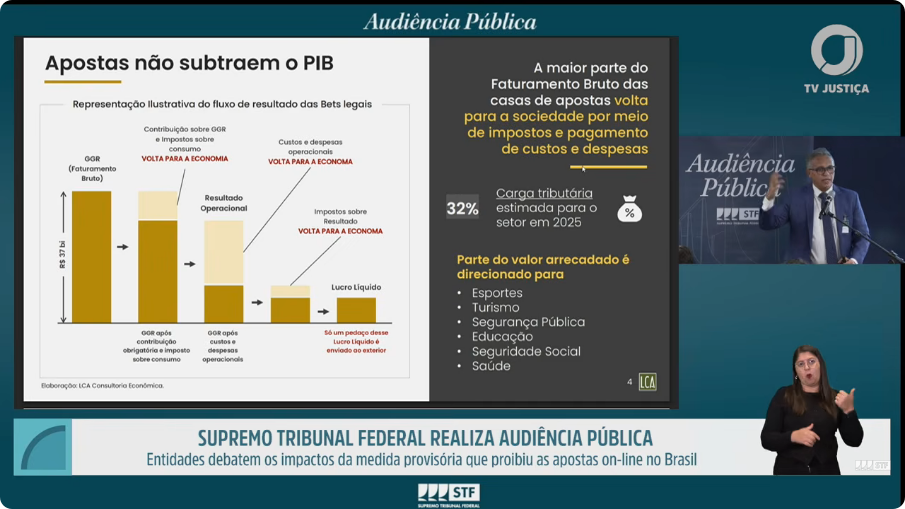
Regarding the claim that betting "subtracts from GDP," the economist spoke of a mathematical inconsistency. Of the R$37 billion, a portion returns to the economy through taxes and the contribution on GGR (Gross Generating Risk). Another portion goes to salaries, suppliers, sponsorships, and sports marketing. Then, corporate income tax (IRPJ) and social contribution on net profit (CSLL) are levied on the result. Only the eventual remittance of profits to foreign shareholders would leave the country, and even that is limited, since the regulations require a Brazilian partner.
According to him, it's legitimate to discuss whether the sector generates a smaller multiplier effect than others. However, saying that it reduces GDP is unsustainable.
The data from ABRAS itself
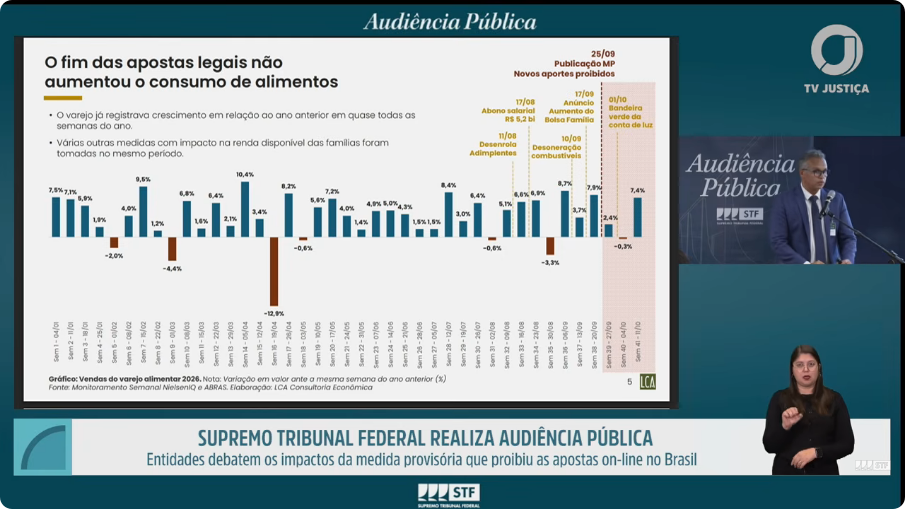
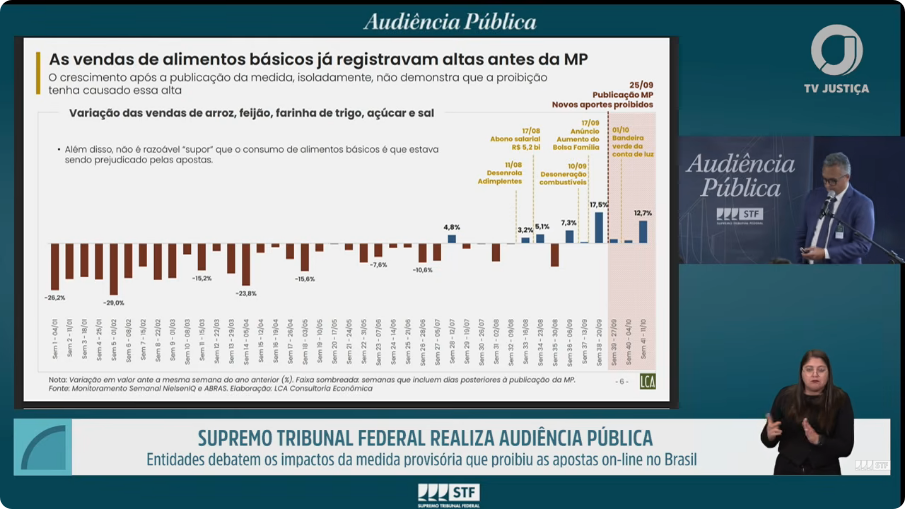
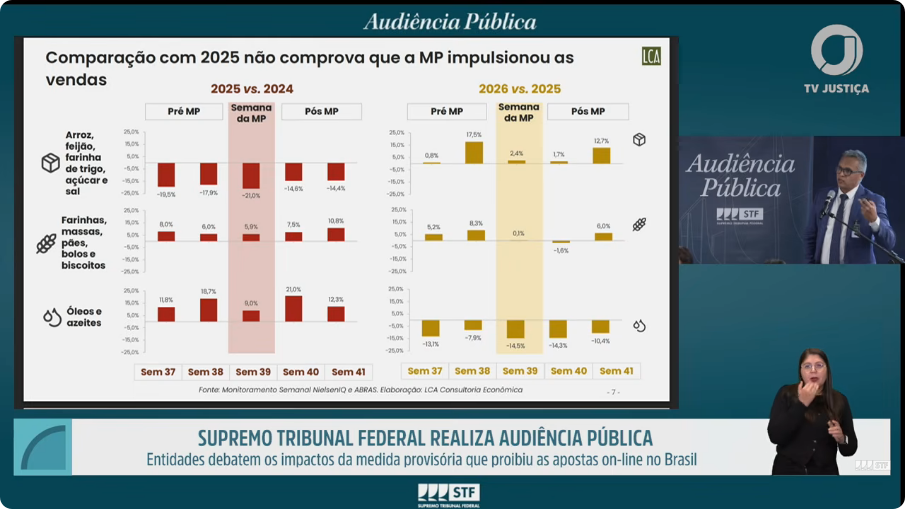
The economist also used weekly figures from the Brazilian Supermarket Association (ABRAS), cited hours earlier by the organization's president, João Galassi, as proof that the end of the betting system increased food consumption. Erick Brasil's interpretation was different: the data shows neither correlation nor causality.
The growth in sales compared to the same weeks of 2025 had already been occurring throughout almost the entire year. This is true even for rice, beans, and wheat flour, items highlighted by ABRAS. Furthermore, the increase in the last three weeks, following the Provisional Measure, was not exceptional. A simple before-and-after comparison showed that the post-Provisional Measure variation, in several categories, was not greater than before.
He also recalled that the minimum wage adjustment was part of a broader “package of benefits” launched on the eve of the election, with several measures capable of influencing consumption. And he noted the difference in scale: the R$ 37 billion of the GGR is equivalent to just over 3% of supermarket revenue. “There’s no way the betting sector could have been so significant for such a large industry in such a short period of time.”
Where there is a correlation: illegal websites
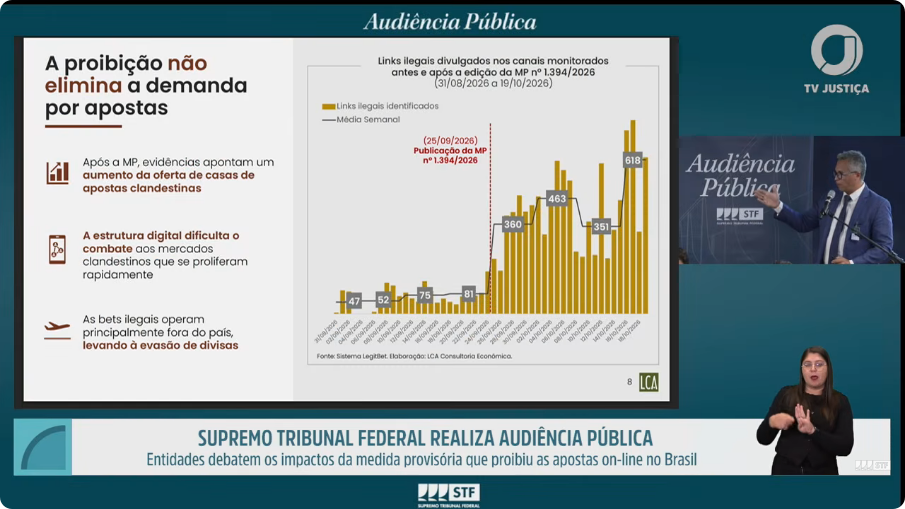
The only strong correlation the economist found was between the Provisional Measure and the proliferation of illegal websites, according to LegitBet's monitoring. He cautioned that supply does not equal demand, and that LCA is still studying whether demand for the illegal market has grown. But he was direct: the illegal sector saw a business opportunity in the prohibition.

"Who governs the game: the State or illegality?"
With just over a minute remaining, lawyer Ana Clara Marques de Barros Santos opened her speech with a message to the court: it is not up to the Supreme Court to make political judgments about what is good or bad, convenient or inconvenient, but to say what is constitutional or unconstitutional.
She lamented that the government does not regularly release data from the Betting Management System (Sigap), which, according to her, would help to debunk fake news. She also pointed out that fixed-odds betting is, by legal definition, a lottery modality. If Caixa is a benchmark in traditional lotteries with social purposes, why not follow the same model in betting, including through the bank itself?
In the field of public health, Ana Clara cited two sets of official data:
⇒ Lenad 3 (2024): more than 90% of gamblers gamble recreationally, and only 0,8% develop a gambling disorder.
⇒ Secretariat of Prizes and Bets (SPA/MF): 70% of bettors spent up to R$ 50 per month, with an average session time of 12 minutes. The figures were presented at a hearing in the Chamber of Deputies.
In closing, the lawyer quoted the president of the Brazilian Institute of Legal Gaming (IJL) and editor of BNLData, Magnho José: “The real question is not whether it should exist, but who governs it, the State or illegality. Good people and public authorities should think very carefully before transforming their good intentions into new business for organized crime.”
“Today, we are not discussing who likes gambling or who doesn’t. We are talking about protecting the gambler and legal security,” she concluded. She also recommended that the court hear from the Association of Women in the Gaming Industry (AMIG).

CNC: Secondhand Numbers and Contradictions
Before them, the National Confederation of Commerce of Goods, Services and Tourism (CNC), author of ADI 7721, defended the constitutionality of the Provisional Measure. Its representative complained that no one had mentioned "how many jobs will be lost," but was referring to jobs in the commerce sector. It ignored the workers in the betting sector itself, who are directly affected by the prohibition.
The figures presented came from reports by Agência Brasil and an estimate by the USP research center that bets will withdraw 1,5% of GDP in 2025, precisely the thesis that Erick Brasil, also from USP, classified minutes later as a mathematical inconsistency.
The speech also had other problems. The representative stated that the president "edited, approved, and sanctioned" the provisional measure, but provisional measures are not sanctioned, and this one hasn't even been voted on by Congress yet. He resorted to the dopamine of gamblers and a comparison with the bingo halls of the 1990s. And he ended by talking about another ADI (Direct Action of Unconstitutionality) from the CNC (National Confederation of Commerce), against the driver's license app.

