The government would have to tax almost 80% of betting revenue to compensate for the reduction in IOF (tax on financial transactions).

In addition to what it already collects in taxes and fees from betting sites, the Ministry of Finance would have to collect 77% of the current revenue from betting sites to offset the approximately R$ 20 billion that the government expects to raise with the increase in IOF (Tax on Financial Operations). This assumes that the values declared by betting sites remain at the current average until the end of the year.
The higher taxation of betting websites was cited by government members, the president of BNDES (Brazilian Development Bank), Aloizio Mercadante, and other economists as an alternative to a possible rollback of the IOF (Tax on Financial Operations) increase, which is under attack from Congress and the private sector.
Government data, obtained by Folha through the Access to Information Law, indicates that the average monthly revenue of betting sites is around R$ 2,16 billion. This amount is equivalent to 7% of the money spent by users on the platforms – this rate is the benchmark for the sector, and the remainder is distributed as prizes, according to the platforms.
The revenue figure is in line with data from the Central Bank, which indicates that Brazilians spend an average of R$ 30 billion per month on betting.
Therefore, to offset the R$20 billion IOF tax, it would be necessary to collect approximately R$1,67 billion per month from betting sites, which would represent 77% of their monthly revenue. Currently, these sites already pay 42% of their revenue in fees.
"Taxing bets to offset IOF is a measure without economic basis," declared the National Association of Games and Lotteries in a statement.
The increase in the tax on financial transactions was presented as a measure to help balance public accounts, but it faces resistance because of the consequent increase in the cost of credit for businesses.
The president of the National Confederation of Industry (CNI), Ricardo Alban, suggested on Monday (26) that the government tax bets and big techs and spare the productive sector. The entity, however, did not detail what the proposal would be to implement the plan.
When contacted, the Ministry of Finance said it would not comment.
Under the current online betting law, those who bet on online games have a tax advantage compared to those who play traditional lotteries. The income tax on any profit from bets is 15%, compared to the 30% charged to those who win the Mega-Sena lottery, for example. The bill approved by Congress provided for an exemption for profits up to R$ 2.112, but this section was vetoed by President Luiz Inácio Lula da Silva (PT).
In addition to the typical service sector taxes — ISS, PIS, COFINS, and corporate income tax — companies pay a monthly inspection fee to the Secretariat of Prizes and Bets (SPA) of the Treasury and allocate 12% of their revenue to the Treasury to fulfill social obligations.
The information access requests made by the news report show that companies transferred an average of R$ 259 million per month to the Treasury between February and May.
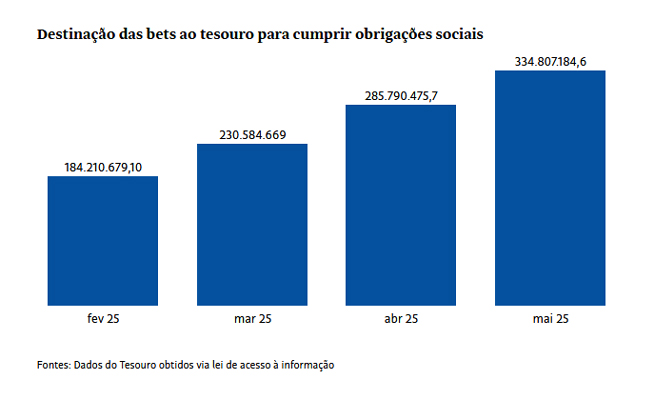
This amount is divided among the Ministries of Health (1%), Education (10%), and Tourism (22,4%), Embratur (5,6%), the Ministry of Sport and other sports entities (36%), the Public Security area (13,6%), as well as other funds and civil society groups.
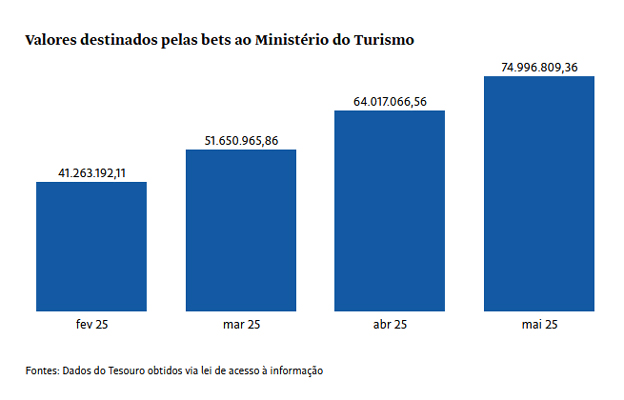
The Ministry of Tourism, the biggest beneficiary, received amounts between R$ 41 million in February and R$ 75 million in May, indicating that betting revenue has been on the rise since the beginning of the year.
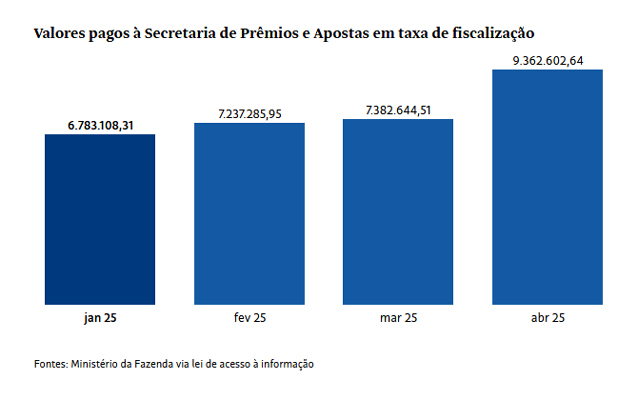
Payments received monthly by the regulator for monitoring betting sites also increased—the amounts collected went from R$ 6,78 million in February to R$ 9,36 million in April. Since the fee is fixed, the trend shows that betting revenue and the number of authorized companies increased during this period.
| Revenue range | Monthly inspection fee amount |
| Up to $ 30.837.749,76 | 54.419,56 BRL |
| From R $ 30.837.749,77 to R $ 51.396.249,60 | 90.699,26 BRL |
| From R $ 51.396.249,61 to R $ 85.660.416,00 | 151.165,44 BRL |
| From R $ 85.660.416,01 to R $ 142.767.360,00 | 251.942,40 BRL |
| From R $ 142.767.360,01 to R $ 237.945.600,00 | 419.904,00 BRL |
| From R $ 237.945.600,01 to R $ 396.576.000,00 | 699.840,00 BRL |
| From R $ 396.576.000,01 to R $ 660.960.000,00 | 1.166.400,00 BRL |
| Over R $ 660.960.000,01 | 1.944.000,00 BRL |
ANJL defends the current revenue collection model. "The model for allocating revenue collected from regulated betting sites is a benchmark for other countries, especially due to the efficient way in which resources are used, benefiting the public interest."
In a statement, the IBJR (Brazilian Institute for Responsible Gaming) assessed that betting "already suffers from high taxation."
Last year, industry organizations lobbied Congress to prevent additional tax levies, arguing that the surcharge favored illegal websites operating without licenses or paying taxes.
The sector estimates that the parallel market receives more than 50% of betting spending in Brazil—that is, approximately an additional R$ 30 billion per year, over which there is no control.
"Combating the illegal market can, in addition to increasing tax revenue, have a positive social impact by protecting bettors and reducing fraud and financial crimes," said the IBJR.