Brazil's Supreme Court hears from parties regarding municipal lotteries and postpones the judgment of ADPF 1212.
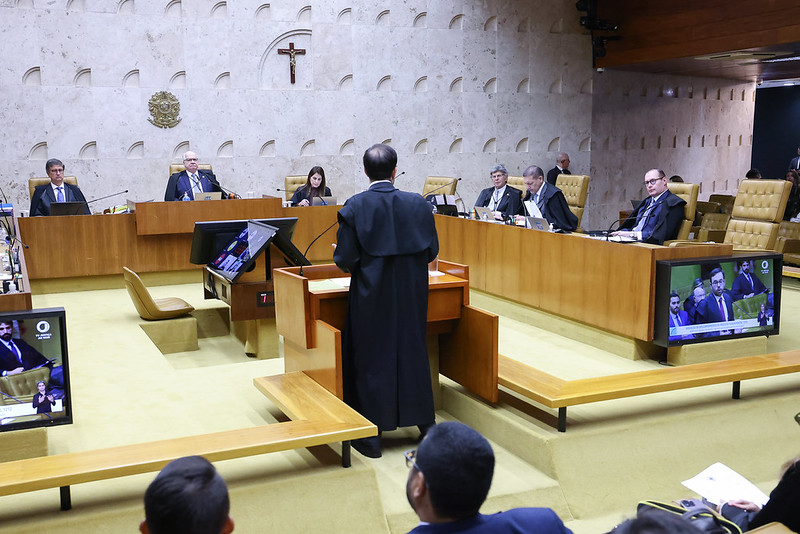
The Plenary of the Supreme Federal Court (STF) began this Wednesday (4) the analysis of the Argument of Non-Compliance with Fundamental Precept (ADPF) 1212 , presented by the Solidarity party against municipal laws and decrees that create, authorize or regulate lotteries and sports betting at the local level. The session, chaired by Minister Edson Fachin, was restricted to the reading of the report and oral arguments. At the end, the judgment was suspended, with no date to be resumed and without any vote cast.
The preliminary injunction issued by the rapporteur, Minister Nunes Marques, on December 13, 2025, suspends all municipal laws and decrees regarding lotteries and sports betting, as well as ongoing bidding processes and the operation of services already licensed, under penalty of a fine of up to R$ 500 per day. The decision began to be reviewed in the virtual plenary session, but was interrupted by a request for a separate hearing from Minister Flávio Dino, which took the case to the physical plenary session.
What the report says
In the report, Nunes Marques listed the regulations questioned by Solidariedade: São Vicente, Guarulhos, Poá, Campinas and the capital, in São Paulo; Belo Horizonte (MG); Foz do Iguaçu (PR); Pelotas and Porto Alegre (RS); Caldas Novas and Anápolis (GO); Bodó (RN); and Miguel Pereira (RJ). The action also covers the creation of municipal lotteries in general, which, according to the party, stems from a misinterpretation of article 30 of the Constitution.
The Attorney General's Office (AGU) and the Prosecutor General's Office (PGR) have expressed their opinions in the case files in favor of the action. The municipalities defended the validity of the regulations based on local interest and precedents from the Supreme Federal Court itself.
Solidarity: from 13 to more than 70 municipalities
The lawyer for the Solidarity party, Ivan Cândido da Silva de Franco, stated that the issue "had been completely out of control in the country" until the Supreme Court's intervention. According to him, the initial petition indicated 13 municipalities with their own lotteries, and by the time the injunction was considered, the number had already exceeded 70.
The most cited case was that of Bodó (RN), a municipality with approximately 2.400 inhabitants that accredited 38 companies, one for every 62 residents. None of them had authorization from the Secretariat of Prizes and Bets of the Ministry of Finance (SPA/MF). According to the lawyer, the municipal authorization cost around R$ 5 per company, while the federal authorization costs R$ 30 million. “What would be the local interest of these companies in operating in a city like Bodó? I'll answer myself: none,” he said. For him, some municipalities functioned as “true hubs” for companies that did not want to submit to federal regulation. He also cited São Vicente and Poá, where the same company allegedly operated fixed-odds betting without SPA authorization and video lottery terminals.
The argument rested on three pillars: the exclusive competence of the Union to legislate on lotteries (article 22, item XX, of the Constitution, and Binding Precedent 2); the lack of local interest; and the precedents of the Supreme Federal Court (STF). According to the lawyer, ADPFs 492 and 493 and ADI 4986, reported by Gilmar Mendes, recognized the material competence of the States based on the residual competence of article 25, without extending it to the municipalities. He also cited ADPF 357, reported by Cármen Lúcia, to classify the municipal model as "self-granted financial super-preference": the municipalities received their share of the federal and state lotteries and still kept all the local revenue.
The lawyer stated that Provisional Measure 1.394/2026, which prohibited fixed-odds betting, does not invalidate the action. The party requested that the Plenary confirm the preliminary injunction, declare the unconstitutionality of all municipal regulations on the subject, and instruct municipalities not to enact similar laws.
City of São Paulo: "bigger than Portugal"
The attorney for the municipality of São Paulo, Simone Andrea Barcelos Coutinho, initially argued that the ADPF (Arguição de Descumprimento de Preceito Fundamental - Claim of Non-Compliance with a Fundamental Precept) should not be considered, due to a violation of the principle of subsidiarity: municipal laws could be challenged through direct action in the state Courts of Justice. She clarified that the capital city enacted the law, but did not implement the service.
On the merits, the prosecutor argued that local interest cannot be measured in the same way in all municipalities. São Paulo, with more than 12 million inhabitants, “has a larger population than the Portuguese Republic,” she said. According to her, São Paulo's law restricted the service to the municipality's territory, and the city hall has geolocation, IP address control, telephone signal monitoring, and VPN blocking capabilities. Regarding gambling addiction, she stated that field research would be necessary to determine whether conventional lotteries induce compulsive gambling like other forms of betting.
Brazil's Attorney General's Office (AGU) considers federal laws to be "unconstitutional."
The Attorney General's Office's Secretary-General for Litigation, Isadora Maria Belém Rocha Cartaxo de Arruda, praised the public hearing convened by Luiz Fux the previous day and brought the government's discourse against betting to the municipal lottery process. She argued that, in the Attorney General's view, federal regulation of fixed-odds betting was insufficient to contain its "externalities," which led to the enactment of Provisional Measure 1.394 and the "unconstitutionality" of Laws 13.756/2018 and 14.790/2023 in the part dealing with betting. In practice, the Union stated that the law approved and regulated during Lula's own government became unconstitutional.
The secretary cited data from the Ministry of Health showing an increase of over 200% in SUS (Brazilian public healthcare system) services related to pathological gambling between 2018 and 2026. She also cited a survey by the Brazilian Association of Supermarkets (Abras) according to which food retail sales grew 6,5% in the week of October 5-11 and 6,3% in the following week, immediately after the Provisional Measure, with rice, oil, pasta, and coffee standing out.
Regarding the merits of the ADPF (Arguição de Descumprimento de Preceito Fundamental - Claim of Non-Compliance with a Fundamental Precept), the AGU (Attorney General's Office) reiterated that the Constitution grants the Union legislative competence and the States residual material competence, while the list in Article 30 does not include lottery services. It recalled ACO 3696, in which Minister André Mendonça stated, in a precautionary measure ratified by the Plenary in the Loterj case, that the flexibilization of territoriality weakens oversight. For the AGU, MP 1.394 "amplifies" the importance of the judgment, because part of the municipal regulations allows the operation of betting establishments by companies without authorization from the Union.

ANJL challenges Abras on the stand
The National Association of Games and Lotteries (ANJL), which brings together federal operators authorized by the SPA, spoke through lawyer Pietro Cardia Lorenzoni and limited its contribution to fixed-odds betting. However, it first directly challenged the Abras data used by the AGU. According to him, three weeks before the ban, the increase in supermarket consumption was 12,8%, and the comparison of 2026 with 2025 shows constant growth in the sector's revenue. "It is not relevant to establish a causal relationship with the ban on bets," he stated. The ANJL pledged to compile the figures in written submissions.
On the merits, the entity sided with the origin. For Lorenzoni, experience showed that municipal fixed-odds betting was not sustainable within the municipality's territory and was used as a "quick and less regulated" shortcut to national exploitation. According to him, calls for bids requiring georeferencing were not respected in practice, there was tolerance from the entities towards national activity, and low levels of compliance with Law 14.790 and the Consumer Protection Code.
Anseja: "Don't take the municipalities out of this game"
Lawyer Ana Sofia Cardoso Monteiro Signorelli, from the National Association for the Legal Security of Games and Betting (Anseja), defended the municipalities based on their fiscal situation. According to the National Confederation of Municipalities, 54% of them ended 2024 in the red, with a deficit of R$ 33 billion. In the states, according to the Independent Fiscal Institution, the aggregate primary result fell from R$ 28,9 billion in 2024 to R$ 400 million in 2025.
The lawyer stated that the Constitution separates legislative competence, which belongs to the Union, from material competence, which would belong to the States (article 25) and municipalities (article 30, items I and V). Anseja proposed a conforming interpretation of article 35-A of Law 13.756/2018, included by Law 14.790/2023, to allow municipal exploitation provided that general federal rules and four criteria are followed: integrity and traceability, fiscal mechanisms, competitive selection and transparency in allocation, and inter-federative cooperation. "It is true that the constituent assembly granted the Union the prerogative to write the rules of the game, but it is at the municipal level that the game is played at home," she said.
The state of São Paulo defends its concession.
The São Paulo State Attorney, Renata Passos Pinho Martins, summarized the argument in one sentence: “The authority to operate lottery services does not extend to municipalities.” According to her, if lotteries were a service of local interest, the authority would be exclusive to the municipality, and the Supreme Federal Court (STF) could not have granted it to the Union and the States. Five of the challenged laws are from municipalities in São Paulo, and others were enacted during the course of the action.
The prosecutor presented the São Paulo model, tendered based on State Law 17.386/2021 and Decree 68.596/2024: operation restricted to the state territory, only modalities foreseen in federal legislation, and revenues destined for social assistance. According to her, municipal lotteries overlap with a service already provided by the State and subject the same bettor to different oversight regimes.
Box: Bodó's numbers
The representative from Caixa Econômica Federal gave a history of federal lotteries and mentioned the resources allocated to the Brazilian Paralympic Committee by Law 10.264/2001. According to him, on average 40% of the revenue from federal lotteries goes to public policies and 40% to prizes.
He presented new figures regarding Bodó: of the R$415 million collected, 2%, or approximately R$8 million, remained with the municipality, and R$409 million “had another destination.” The lawyer also stated that in federal lotteries “there is no gambling addiction, there is no such risk,” because the results take a few days to be announced. This statement was not accompanied by any supporting data.
Abrasf: Neapolitan Smorfia and carnival
Last to speak, lawyer Ricardo Almeida Ribeiro da Silva, from the Brazilian Association of Finance Secretariats of Capital Cities (Abrasf), requested the dismissal of the action and the revocation of the injunction. He stated that fixed-odds betting “has been contaminating” the discussion and that the ADPF (Arguição de Descumprimento de Preceito Fundamental - Claim of Non-Compliance with a Fundamental Precept) deals with traditional lotteries, such as Loteca, Loteria Federal, Timemania, Keno, and scratch cards, without a history of damages comparable to those of online games. Bodó, he said, is a “caricatured example.”
The lawyer recalled the lotteries that financed charitable institutions and public buildings since the 19th century, cited the Smorfia Napolitana, a tradition linked to the Naples lottery, and accused the Union of practicing "competitive federalism" and wanting "to have a monopoly, including with Caixa Econômica Federal, on lotteries." According to him, the logic of the action could limit other municipal entertainment revenues: "Everyone likes Carnival, it seems that lotteries have this prejudice."
Joint trial
After the oral arguments were concluded, Fachin proclaimed the provisional result: judgment suspended after the report and oral arguments. According to TV Justiça's analysis, Ministers Flávio Dino and Luiz Fux made considerations at the end of the session, and the president took into account the convenience of judging the case together with the other proceedings on the subject: the ADIs against Law 14.790/2023, the actions against MP 1.394, which are with Fux, and the extraordinary appeal on the constitutionality of the prohibition of gambling.
When the trial resumes, the full court will decide whether to uphold Nunes Marques' preliminary injunction and proceed to the merits of the case.
Counterpoint: the Abras data
The Abras figure, repeated by the Attorney General's Office in the Plenary, has already been challenged by BNLData. The week measured, from October 5th to 11th, coincided with the end of the deadline for voluntary withdrawals of balances on the platforms, which ended on October 5th, when millions of bettors withdrew money previously held in their accounts. Furthermore, Children's Day in 2026 (October 12th) fell on a Monday, creating a long weekend, while in 2025 the date was on a Sunday, inflating the annual comparison. Abras did not present any controls for any of these factors. The ANJL's challenge in the plenary session goes in the same direction.