
Barreirinhas vs. Barreirinhas: the secretary who praised the regulation now calls the market "pseudo-regulated."
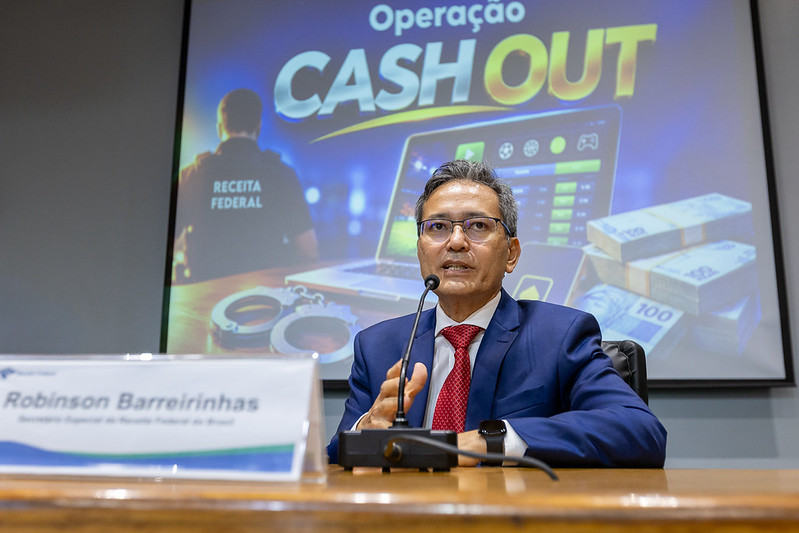
On the morning of this Wednesday (18), the Special Secretary of the Federal Revenue, Robinson Barreirinhas, opened the press conference in the auditorium of the Ministry of Finance about Operation Cash Out, conducted by the Revenue, the Federal Public Prosecutor's Office and the Federal Police against a betting group based in Pernambuco. The search and seizure warrants and the blocking of R$ 2,32 billion were authorized by the Judiciary, based on information from the Revenue, Gaeco and the Secretariat of Prizes and Bets (SPA). No one was judged. Even so, the tone of the press conference was that of a sentence, and not only about the investigated group, but about the entire sector.
BNLData compared the secretary's statements on Wednesday with what he himself has said about the same market in recent years. The difference is significant.
The 2018 law: from "legalization" to "pseudo-regularization"
On March 11, 2025, in testimony to the Senate's Betting CPI (Parliamentary Commission of Inquiry), Barreirinhas clearly pointed out where the flaw lay: "legalization occurred in 2018 but regulation was not implemented." He added: "the law is good, what failed was really the lack" of regulation. In the same session, he noted that regulation "was an important step, I need to record that" and that "it's better to have the law regulated today, and for us to have more data starting in January, than nothing at all."
On Wednesday, the same period became something else entirely. According to the secretary, gambling was "pseudo-regulated in Brazil, back in 2018, 2019, but without any regulation whatsoever." The State's omission, which he acknowledged in 2025, disappeared from his discourse. Law 13.756/2018 legalized fixed-odds betting and stipulated that the Ministry of Finance regulate it within two years, extendable for another two. The deadline spanned the entire Jair Bolsonaro administration and reached the Lula administration without the regulation being issued. Only in December 2023 did Law 14.790 come into effect, improving the 2018 law. Throughout 2024, the SPA (Sociedade de Políticas de Gambles) issued dozens of regulations to govern the sector, and the Legislature itself provided for an adaptation period, with the regulated market in effect from January 1, 2025.
The "vote of confidence" that disappeared.
In the CPI (Parliamentary Commission of Inquiry), Barreirinhas made a distinction between companies that presented themselves to the government and those that continued to operate outside the law. To the former, he promised: "To those that regularize their situation, I will give the vote of confidence that the Revenue Service should give to all taxpayers." And he went further: "I cannot discourage those that have adapted to the legislation, whether we agree with the legislation or not."
In the press conference, the secretary stated that the modus operandi under investigation "is now quite clear that it is a modus operandi extended, unfortunately, to a good part of the gaming and betting sector here in Brazil." He also classified the activity as something "that causes so much harm to the Brazilian population." When questioned about licenses, he himself made the caveat: "I cannot say that this happened in all cases, that would be reckless." The statement contradicts the generalization made minutes earlier.
The regulation he criticizes is the one that allowed the investigation.
Barreirinhas himself recounted how the case began. With the 2023 law, the Internal Revenue Service intensified its intelligence work with the SPA "due to the analysis of the suitability of those who were applying." That is how, still in 2024, the Internal Revenue Service filed a complaint with the Federal Public Prosecutor's Office against the group now under investigation.
In other words, the investigation only exists because the market was regulated. In 2025, the secretary said exactly that: with regulation, "the Federal Revenue Service now has what it didn't have until now, which is information, basic information."
The report raises a question that the press conference did not answer. If the Internal Revenue Service had already pointed out the group to the Federal Public Prosecutor's Office in 2024, why did the Ministry of Finance, to which the Internal Revenue Service and the SPA are subordinate, grant the authorization in 2025?
The theory of money "returning to the economy"
Barreirinhas used the press conference to repeat a thesis he had already presented in an interview with the newspaper O Globo in October. According to him, the resources from betting "have now returned, with the prohibition in Brazil, to flow into the Brazilian economy." Just as in the interview, the secretary did not present any study, projection, or data to support this claim. And he ignored the signs that a large portion of bettors have migrated to the illegal market, rather than to consumption. The consulting firm H2 Gambling Capital estimates that the prohibition will bring R$ 25 billion per year to the clandestine market, and the Brazilian Institute for Responsible Gaming (IBJR) says it has identified more than 60 illegal websites since the prohibition. Even members of the government, such as the Minister of Social Development, Wellington Dias, and the president of COAF (Council for Financial Activities Control), Ricardo Saadi, have already admitted this migration.
This is the same secretary who, in January 2026, presented the federal revenue figures, projecting R$ 9,95 billion for 2025, as a significant increase.
The grant that will not be returned.
Asked about the return of the concessions, Barreirinhas was direct: "The federal government's position is that the concession is not a deposit that can be returned; a fee was paid for the exploitation during the authorized period."
The R$30 million grant guaranteed five years of operation. Provisional Measure 1.394, which prohibited betting, terminated the authorizations after about 21 months. According to the secretary's own logic, the amount corresponding to the remaining years was paid without any counterpart, and this applies to all authorized companies, including those that are not the subject of any investigation.
Numbers that need explaining
In the press conference, the regional public prosecutor Fábio George, deputy coordinator of the National Gaeco, stated that the group's actual financial transactions in 2025 would amount to R$ 11 billion, while the declared values were R$ 2 billion, "therefore 15% of those transactions." The calculation is incorrect: R$ 2 billion corresponds to approximately 18% of R$ 11 billion.
There is a more important issue. The Federal Public Prosecutor's Office (MPF) did not specify what each number measures. If the R$11 billion refers to the total amount wagered and the R$2 billion to the declared revenue, the difference does not, in itself, indicate tax evasion. Most of the wagered amount returns to bettors in the form of prizes, and the revenue of an operator, the so-called GGR, is the difference between bets and prizes. Revenue around 18% of the wagered volume is within the market standard.
What is at stake
The suspicions being investigated in Operation Cash Out are serious:
⇒ Currency evasion and money laundering
⇒ Using the CPF numbers (Brazilian taxpayer ID numbers) of deceased individuals, minors, and companies as if they were bettors.
⇒ Shell companies used to justify remittances
If proven, they should be punished to the full extent of the law. That is precisely why it is up to the courts, and not a press conference, to decide on them.
The operation comes at a time when the government is defending the maintenance of the provisional measure that banned betting. Using an ongoing investigation to turn an entire sector into a suspect, and to place under the same suspicion companies that paid the grant, complied with the rules and are not the target of any accusation, is the opposite of what Barreirinhas itself defended less than two years ago.

