In the Supreme Court, the regulated sector points to a "foundational error" in the Provisional Measure on Betting: prohibiting gambling does not make it disappear.
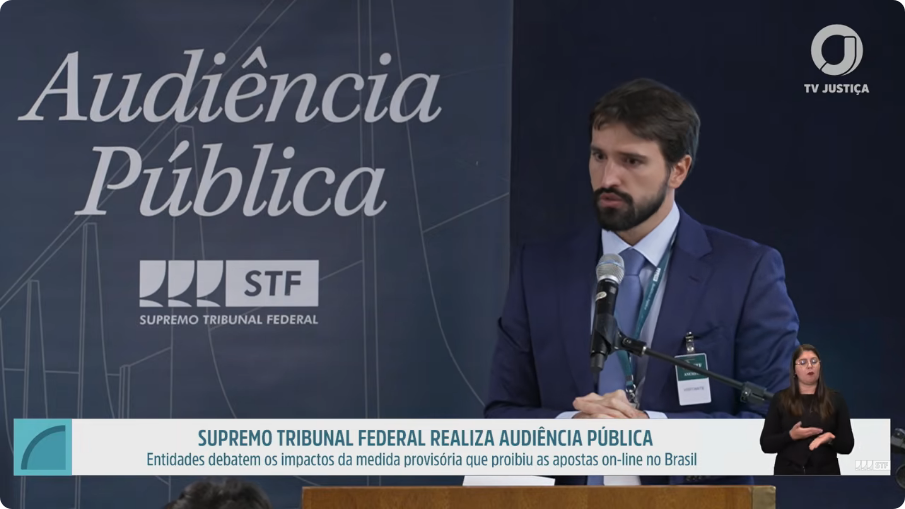
The afternoon of the public hearing at the Federal Supreme Court on Provisional Measure 1.394/2026, this Tuesday (3), was dedicated to entities in the gaming and betting sector and to lawyers. The speakers took turns at the podium before the rapporteur, Minister Luiz Fux, with a common thesis. For them, the government assumes that prohibiting means ending gambling, and Brazilian history disproves this idea.
ANJL: "the dragon already existed"
Speaking first, Pietro Lorenzoni, from the National Association of Games and Lotteries (ANJL), pointed out a "premise error" in the speeches of the government authorities who preceded him. According to him, the authorities treat the prohibition as synonymous with the absence of gambling.
Lorenzoni questioned the data used to justify the Provisional Measure. The Lenad 3 study, which indicates 11 million people with potential gambling-related disorders, is from 2023. This survey predates regulation and covers all forms of gambling, not just regulated betting, which did not yet exist. He also recalled that the CNC study on the impact of gambling on families concludes that the appropriate response is more regulation, not prohibition.
The lawyer reconstructed the chronology of the market. Betting companies have been operating in the country since 2005. In 2013, they were already moving R$ 2 billion, according to Folha de S.Paulo. In 2018, it was more than R$ 5 billion and, in 2023, before Law 14.790, R$ 28 billion. “The regulation was not to create a market. It was an attempt to tame the dragon, but the dragon already existed,” he said, echoing the image used by the Attorney General of the Union, Jorge Messias.
Lorenzoni listed what the operators handed over to the State:
⇒ grants of R$ 30 million each;
⇒ nearly R$ 3 billion to public coffers, in addition to taxes;
⇒ more than R$ 1 billion per year for football;
⇒ R$ 2,6 billion for Olympic and Paralympic sports;
⇒ R$ 1,4 billion in advertising.
He also cited data from the Treasury showing a 32% drop in the volume wagered in 2026 and a channeling of more than 60% to the regulated market. "The regulation was working," he stated. According to the lawyer, the provisional measure also errs in stipulating that no compensation would be due to operators: "A provisional measure cannot protect the federal government from the damages it itself causes."
Lorenzoni intended to show a video demonstrating how easy it is to access a betting website. Fux vetoed the showing. The minister argued that, with the provisional measure in effect, the demonstration could constitute an illegality.
Abracrim: Gambler could face charges for money laundering.
Milton Jordão spoke on behalf of the Brazilian Association of Criminal Lawyers (Abracrim), acting on behalf of the organization's president. He warned that the Provisional Measure leaves dangerous loopholes. The main one: the very gambler it seeks to protect, including the gambling addict, could be held liable for money laundering if they receive funds from a website, because paragraph 2 of article 50 of the Law on Criminal Offenses is in effect.
The criminal lawyer also refuted the government secretary's statement that the Provisional Measure "clears the fog." According to Jordão, the country is "handing over a market with technology, organization, and player data to organized crime on a silver platter." He recalled that Decrees SPA No. 615 and 143 allowed for the initiation of police investigations and stated that this information "is being torn up." "We're going back to the time when the officers were in Curaçao, Gibraltar, and Malta," he said.
Jordão also criticized Bill 5.477, filed shortly after the Provisional Measure to criminalize the activity: "Are we going to rush through criminal legislation again?" Abracrim did not ask for a specific outcome. The organization advocated that Fux consider modulating the effects and ensuring a transition with legal certainty.
Abracopel: a century of the illegal lottery game "jogo do bicho"
The representative of the Brazilian Association of State Lottery Concessionaires and Licensees (Abracopel) said he voted for Lula and that this vote "was not because of the provisional measure." He maintained that the issue under discussion is the abuse of state power.
The speaker cited the jogo do bicho (animal lottery), banned for over a century and still active despite all the repressive apparatus. He also recalled the 2004 Provisional Measure, issued by the same president to end bingo halls. That Provisional Measure was ultimately rejected by the Senate, and bingo halls continue to operate clandestinely. "How do consumer protection agencies protect those who play jogo do bicho?" he questioned. Fux interrupted him and asked that the topic be addressed "without political bias."
The central point of Abracopel's presentation was federalism. According to the speaker, the Provisional Measure revoked the material competence of the states, a competence recognized by the Supreme Federal Court in ADPFs 492 and 493. He stated that eight authorizations from Paraíba, eight from Rio de Janeiro, and two from Maranhão were overturned.

ANSEJA: the fiscal cost was underestimated
Ana Sofia Monteiro, from the National Association for Legal Security of Games and Betting (ANSEJA), author of ADI 8024, presented herself as a jurist and economist. She brought to the podium the data from B-Ready, a World Bank indicator that replaced Doing Business. Approximately 25% of Brazilian entrepreneurs cite regulation as one of the biggest obstacles to investment, compared to 20% in Latin America and 15,5% in Sub-Saharan Africa. According to the speaker, this translates into a regulatory risk premium of 100 to 150 basis points, which also increases the cost of highways, energy, and sanitation.
In the fiscal field, she argued that the impact estimate required by Article 113 of the ADCT (Transitional Constitutional Provisions Act) was underestimated. The explanatory memorandum of the Provisional Measure predicted a loss of R$ 1,5 billion in 2026 and R$ 5,1 billion in 2027. But the 2027 Budget Bill itself, sent weeks earlier, already projected R$ 6,7 billion in fixed-odds betting budget lines. Furthermore, the sector generated approximately R$ 1,2 billion per month in federal revenue between January and August. Adding five months of this revenue to the R$ 6,7 billion, the loss reaches at least R$ 12,7 billion, double the estimate. This calculation does not include:
⇒ the possible proportional return of grants, up to R$ 1,6 billion;
⇒ the lost profits claimed by the operators;
⇒ the inspection costs, previously paid by the operators.
“The prohibition doesn’t make the activity disappear, it makes the activity cease to be taxed,” she stated. She informed that, during the hearing, the TRF3 (Regional Federal Court of the 3rd Region) granted an injunction suspending the effects of the Provisional Measure for an appealing company.
The lawyer also pointed out a competitive inconsistency. The provisional measure prohibits fixed-quota lotteries, which retain about 17,7% of the wagered amount, and preserves lotteries operated exclusively by Caixa Econômica Federal, which retain about 66%. She agreed with Douglass North, Nobel laureate in Economics: "the owner of the betting shop cannot change the rules in the middle of the game."

IBJR requests injunction.
The Brazilian Institute for Responsible Gaming (IBJR), author of ADI 8027, limited its speech to the request for an injunction. The entity wants the effects of the Provisional Measure suspended until Congress pronounces itself or until the merits of the case are judged. According to the speaker, there is no urgency in a topic debated for years in Congress, which opted for regulated gambling. "I haven't heard anyone here say they have a magic recipe to end illegal gambling," he stated. He argued that the Provisional Measure places Congress before a fait accompli, because the damage will have already occurred when the measure is voted on.
The closing of the hearing was the responsibility of the State Attorney General's Office and the Ministry of Sports, represented by the minister's staff.